Major firms cite AI as a trigger for cuts
The most visible reductions have come from technology and consumer-facing corporations. Amazon said it will shed about 14,000 corporate roles while channeling capital toward its “biggest bets,” a category that explicitly includes generative AI. Consulting giant Accenture, cloud software provider Salesforce, airline group Lufthansa and language-learning platform Duolingo have all signaled that automation and machine learning are factors in their workforce plans.
Although the current savings may appeal to shareholders, academics and recruiters caution that eliminating junior posts can create structural weaknesses. Fabian Stephany, assistant professor of AI and work at the Oxford Internet Institute, referred to the risk of a “talent doom cycle” in which firms lose the ability to develop future leaders internally and must later compete for experienced hires at inflated salaries.
Investment versus short-term efficiency
Chris Eldridge, chief executive for the U.K. and North America at recruitment firm Robert Walters, described entry-level hiring as an investment comparable to research and development. “If you remove too many junior roles, you can starve the internal talent pipeline,” he said. Without a steady cohort of new professionals, companies may face talent bottlenecks that drive up recruitment costs and weaken institutional knowledge.
Eldridge also pointed to the cultural dimension. Younger employees often act as “culture carriers,” absorbing tacit knowledge—unwritten information about how an organization functions—and transmitting it forward. Eliminating that layer can disrupt mentoring relationships and erode the informal networks that keep day-to-day operations running smoothly.
Generational bridge and reverse mentoring
Stephany emphasized the importance of maintaining a workforce that reflects society. A team composed largely of late-career employees may struggle to anticipate consumer trends or innovate at speed. Early-career staff frequently introduce ideas that challenge established practices, and their familiarity with emerging technologies can create opportunities for reverse mentoring.
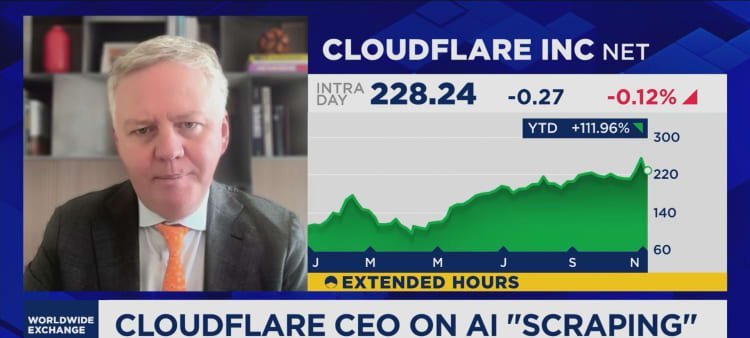
Imagem: Getty
Cloudflare co-founder and chief executive Matthew Prince recently outlined such an approach, announcing plans to hire 11,000 interns despite broader belt-tightening in the tech sector. Prince argued that senior leaders need guidance from digital-native employees to exploit AI effectively.
Economic and social stakes
Beyond individual companies, reduced access to entry-level roles could have macroeconomic implications. If large cohorts of graduates remain under-employed, overall productivity growth may slow. Historical data from the U.S. Bureau of Labor Statistics show that younger workers play a significant role in diffusion of new skills and technologies across industries, an effect that could weaken if hiring channels narrow.
The competition for the remaining positions is already intense. Revelio Labs’ 35% decline in junior listings coincides with broader layoffs across the technology, finance and professional-services sectors, leaving many recent graduates with limited pathways into stable careers.
What comes next
Analysts say the direction companies choose in the next two years will determine whether the current reduction in junior roles is a temporary cost-saving measure or the beginning of a systemic shift. If businesses continue to prioritize AI deployment over entry-level hiring, they may confront higher future staffing costs, cultural stagnation and knowledge gaps that slow innovation.
Conversely, organizations that sustain graduate schemes, internships and apprenticeship programs may gain a competitive edge by blending automation with human creativity and institutional continuity. Eldridge summed up the consensus among recruiters: “You are missing a significant aspect of growth if you shut down the pipeline on bringing junior or entry-level talent into an organization.”
Crédito da imagem: Cemile Bingol / DigitalVision Vectors via Getty Images


