Tariffs on eight European countries
Before departing Washington for Switzerland, Trump announced a 10 percent tariff on all goods arriving from Denmark, Norway, Sweden, France, Germany, the United Kingdom, the Netherlands and Finland. The duties are set to take effect on 1 February and rise to 25 percent on 1 June unless the United States obtains “complete and total control” of Greenland. The president justified the measure as a response to “uncooperative behavior” after those countries sent small troop contingents to Greenland last week for what they described as a routine security exercise.
During a brief exchange with reporters outside the White House, Trump said the United States “needs [Greenland] for national security and even world security.” Asked how far he was willing to go, the president replied, “You’ll find out,” signaling no retreat from the administration’s stance.
European institutions promise a united reply
At Davos, European Commission President Ursula von der Leyen called the proposed tariffs a mistake that risk plunging transatlantic relations into a downward spiral. Referring to a U.S.–EU trade accord concluded in July, she told delegates, “A deal is a deal,” and warned that Brussels would react in a “united and proportional” manner if Washington moved ahead.
European Council President Antonio Costa echoed those remarks, stating that further duties “undermine transatlantic relations and are incompatible with the EU-US agreement.” He pledged to defend European citizens and businesses against “any form of coercion.”
French President Emmanuel Macron, addressing the forum in a separate session, described the accumulating tariffs as “fundamentally unacceptable—especially when they are used as leverage against territorial sovereignty.” Paris later urged the North Atlantic Treaty Organization to organize a new exercise in Greenland, saying it was prepared to contribute personnel and assets.
Security posture in the Arctic
Although Greenland’s population numbers fewer than 60,000, the island occupies a strategic location in the Arctic and hosts abundant mineral reserves. Analysts note that the rapid retreat of sea ice is opening previously inaccessible shipping lanes and resource deposits, elevating geopolitical interest among the United States, Russia and China. NATO has increased its presence in the High North, reflecting concerns spelled out in the alliance’s strategic concept (NATO official site).
Denmark’s defense ministry said the frigate HDMS Knud Rasmussen continues to patrol waters near Nuuk, Greenland’s capital, as part of routine operations. Copenhagen has also expanded satellite monitoring and air-surveillance flights in coordination with allied forces.
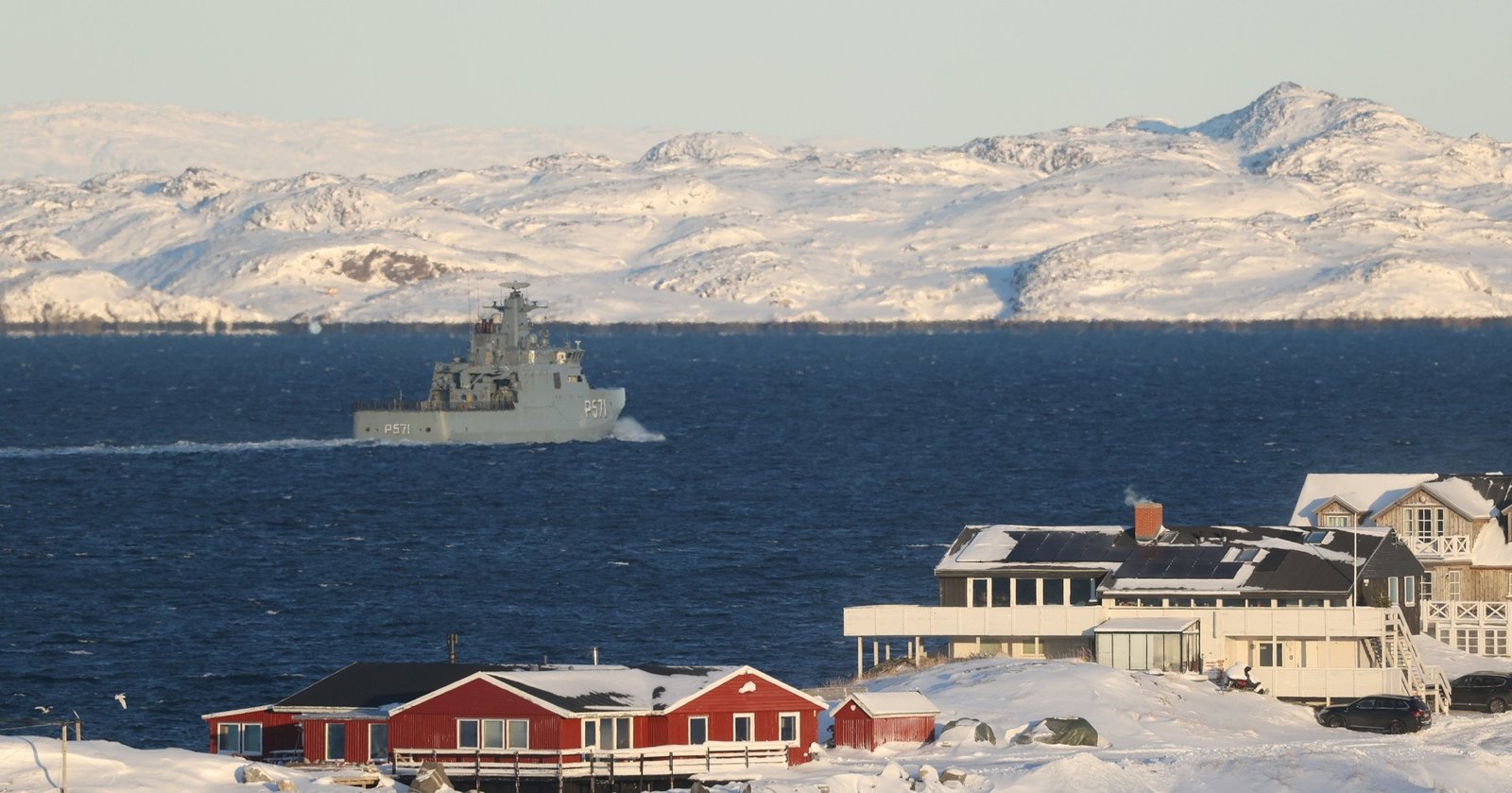
Imagem: Internet
Greenland’s response
Greenlandic Prime Minister Jens-Frederik Nielsen posted on social media that the territory must be “prepared for the worst.” Although he considers an armed confrontation unlikely, Nielsen argued that complacency was not an option. His government, he wrote, remains in “constant dialogue with the EU and NATO and others” about the developing situation.
Greenland’s parliament, the Inatsisartut, plans to convene an extraordinary session next week to discuss emergency preparedness, trade disruptions and possible legal avenues for challenging any unilateral American action.
Next steps at Davos
Trump is due to deliver his WEF keynote on Wednesday afternoon local time. Forum organizers have placed security around the main Congress Centre on high alert, citing heightened tensions associated with the Greenland dispute. Multiple bilateral meetings between U.S. officials and European counterparts have been scheduled on the sidelines, but diplomats say the agenda could shift rapidly depending on the content of the president’s remarks.
Meanwhile, trade ministers from the eight affected European countries met informally on Tuesday evening to coordinate potential counter-measures. Participants said discussions covered targeted tariffs on U.S. consumer goods, a joint case at the World Trade Organization and expanded cooperation on critical raw materials to reduce reliance on American suppliers.
Global economic implications
Analysts warn that a protracted tariff dispute could weigh on growth in both North America and Europe. The eight European nations targeted last year accounted for approximately $275 billion in merchandise exports to the United States, according to data compiled by Eurostat. Sectors ranging from automotive manufacturing to pharmaceuticals may face higher costs and supply-chain disruptions if duties escalate to the 25 percent level outlined by the White House.
Beyond trade, security experts say any aggressive move toward Greenland would test NATO’s principle of collective defense. Earlier this week, U.S. Representative Michael McCaul, chair of the House Foreign Affairs Committee, told reporters that an American invasion “would mean war with NATO itself,” underscoring political resistance even within Washington.
For now, the focus remains on Davos. As delegates prepare for Trump’s address, several European officials said they hoped for a conciliatory message but were prepared for the opposite. In the words of one senior EU diplomat, “We will listen carefully—but we will also respond collectively.”
Crédito da imagem: Sean Gallup/Getty Images


