Capital spending forecast rises sharply
The focal point for investors was Amazon’s revised investment plan. Management told analysts it now expects approximately $200 billion in capital expenditures during 2026. FactSet data had indicated market expectations of roughly $146.6 billion. For comparison, Amazon disclosed capital outlays of about $131 billion in 2025.
Chief Executive Officer Andy Jassy said on the conference call that the additional spending will “predominantly” support AWS infrastructure, including data centers equipped for artificial-intelligence workloads. The company opened Project Rainier, an $11 billion AI-focused facility, in October and continues to add capacity as cloud customers request more compute and storage. Jassy also cited ongoing investments in custom chips, robotics and a low-earth-orbit satellite network.
The aggressive plan aligns Amazon with other technology firms escalating AI commitments. Alphabet this week projected capital expenditures of $175 billion to $185 billion in 2026, while Meta Platforms outlined a potential range of $115 billion to $135 billion. The scale of the industry’s spending wave underscores competition to supply infrastructure for generative-AI applications.
Guidance for current quarter
For the first quarter ending in March, Amazon forecast revenue between $173.5 billion and $178.5 billion, representing growth of 11% to 15% from a year earlier. The midpoint of that range, $176 billion, is close to the $175.6 billion average analyst estimate. Operating-income guidance was not disclosed in the excerpt provided, but management emphasized that profit trends remain sensitive to the timing of fulfillment and content costs.
Cloud leadership and competitive landscape
Although Amazon remains the leading provider of cloud infrastructure services, rivals have been growing faster. Microsoft last week reported 39% expansion at Azure, and Google Cloud posted 48% growth, its strongest result since 2021. By highlighting the acceleration at AWS and the planned infrastructure build-out, Amazon sought to reassure investors that it can maintain its edge as customers shift both conventional and AI-centric workloads to the cloud.
During the call, Jassy noted that “non-AI workloads are growing at a faster rate than we anticipated,” suggesting demand is broad-based. He added that the company is “monetizing capacity as fast as we can install it,” indicating that utilization rates remain high despite the sizable build program.
Workforce adjustments continue
The company’s cost structure also reflects ongoing reductions in corporate staff. Amazon said last week it would eliminate about 16,000 positions, following approximately 14,000 cuts announced in October. Total global headcount stood at 1.57 million at the end of December, up 1% year on year, a figure dominated by warehouse employees hired to support peak holiday volumes.
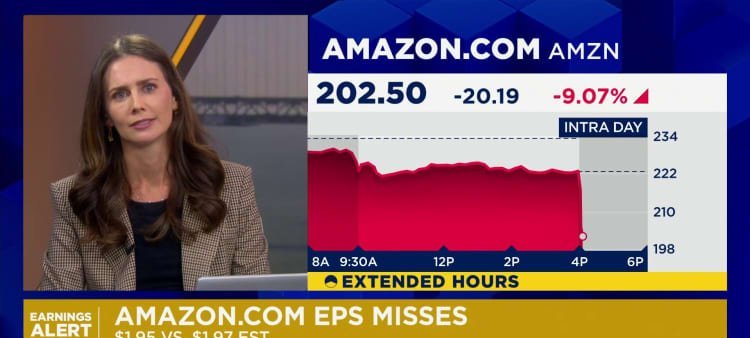
Imagem: Internet
Advertising momentum
Advertising remains an important earnings driver. The 23% increase to $21.32 billion outpaced overall revenue growth and underscored the segment’s resilience amid broader macroeconomic uncertainty. Amazon continues to expand formats for sponsored listings and video, leveraging the reach of Prime Video and Twitch to attract brand spending.
Market reaction and broader context
Despite exceeding revenue estimates, the combination of a slight earnings miss and a markedly higher spending trajectory weighed on sentiment. The stock’s double-digit decline in extended trading erased part of the rally it had enjoyed after reporting strong third-quarter results in November.
Analysts noted that return on invested capital will be closely watched as the company executes its $200 billion plan. Amazon stated that it expects “strong long-term returns,” but acknowledged that near-term free-cash-flow metrics could fluctuate as construction accelerates.
The Securities and Exchange Commission’s public filings database provides detailed breakdowns of Amazon’s historical capital commitments, offering investors a baseline for comparing the upcoming surge in spending.
While management framed the higher capex as necessary to meet robust demand for AI services, equity markets appeared skeptical that revenue growth will keep pace with the outlays in the short run. The reaction was consistent with recent trading patterns in the sector, where companies making large AI bets have faced share-price volatility.
Amazon will hold its annual shareholder meeting later this spring, when investors are expected to seek further clarification on milestones for its data-center expansion, satellite deployment schedule and anticipated payback periods.
Looking ahead, the company’s ability to balance heavy infrastructure investment with cost controls in core retail operations will remain a key determinant of profitability. With guidance implying solid, though moderating, top-line growth in early 2024, the focus is likely to stay on margin trends and cash-flow generation as the capital-spending cycle ramps up.
Crédito da imagem: [nome da fonte original]