Research from the University of Leeds that compared decades of satellite imagery found that portions of Greenland’s ice sheet have been replaced by wetlands, shrubs and barren terrain. For mining firms, that environmental change has removed some of the physical barriers to exploration.
Interest from investors has climbed accordingly. Critical Metals, whose southern Greenland project is regarded as one of the world’s largest rare earth prospects, reports a surge in inquiries since Trump renewed talk of U.S. involvement on the island. Chief Executive Tony Sage says the shift underscores how strategic materials have moved to the top of political agendas.
Amaroq, another exploration company active in Greenland, is expanding beyond gold after identifying high-grade rare earth mineralization in the island’s south. One week after that announcement, on Nov. 11, the firm confirmed commercial levels of germanium and gallium at its west Greenland hub. Management describes the find as potentially more consequential than the rare earth discovery because both metals are critical for electric vehicles, semiconductors and numerous defense technologies.
China is currently the dominant producer of germanium and gallium. In 2023, Beijing imposed export controls on the two metals, then issued a full ban on shipments to the United States later the same year in response to chip-sector restrictions announced by Washington. Although the ban was subsequently suspended, the materials are still subject to strict licensing rules. Supply from Greenland could therefore give Western buyers a partial hedge against future disruptions.
Amaroq plans to generate near-term revenue by mining zinc, lead and silver, with rare earth extraction to follow once feasibility work is complete. Executives stress, however, that the niche market for rare earths demands careful pacing and sustained financing.
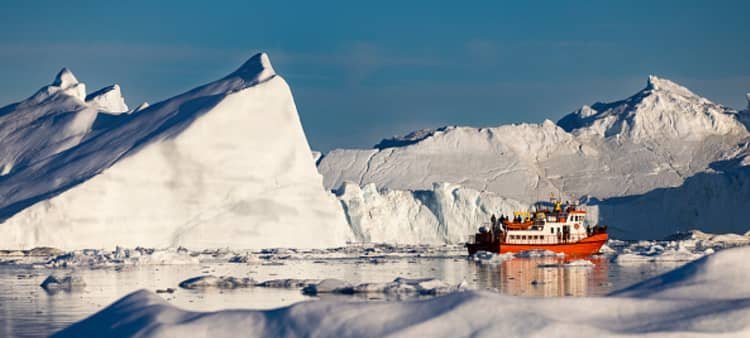
Imagem: Internet
Despite the heightened activity, specialists caution that operating in Greenland remains complex. Infrastructure is limited, weather can be severe even during summer, and virtually all heavy equipment must be imported. Under favorable conditions, some estimates suggest it could take 15–20 years before a new mine achieves meaningful profitability.
The scramble is not limited to Greenland. In Arctic Sweden, state-owned LKAB is advancing development of the Per Geijer deposit, revealed in 2023 as one of Europe’s largest known concentrations of rare earth elements. The deposit lies adjacent to LKAB’s longstanding iron-ore mine in the city of Kiruna, providing the firm with rail links, power and a skilled workforce.
Senior managers at LKAB say engagement with European policymakers is underway to ensure the economics of the project add up. Even with existing infrastructure, the company argues that high capital costs, permitting hurdles and uncertain pricing make investment decisions complex—conditions it believes could be tougher for firms elsewhere on the continent.
Broader policy discussions have intensified within the European Union, the United States and allied economies. Data from the U.S. Geological Survey indicate that demand for rare earths is expected to expand as clean-energy technologies, advanced electronics and defense systems proliferate. Against that backdrop, Arctic deposits represent a potential, though challenging, route to strengthen supply security.
For now, the region offers both promise and uncertainty. Climate change and geopolitical rivalry have opened a window of opportunity, but harsh operating conditions, long lead times and significant capital outlays mean the Arctic’s mineral wealth will not be unlocked quickly. Governments and companies pushing northward are betting that the strategic payoff will justify the cost.
Crédito da imagem: Bloomberg via Getty Images


