Guest appearances anchored several moments. Lady Gaga joined halfway through to deliver a salsa-inflected arrangement of her song “Die With a Smile.” Dressed in a light-blue gown accented by a red flower, she briefly partnered with Bad Bunny for a choreographed dance, while a brass-forward band in red suits backed the duo. Ricky Martin followed with an extract of “Lo Que Le Pasó a Hawaii,” exchanging vocals with the headliner. Influencer Alix Earle, rapper Cardi B, actor Pedro Pascal and actress Jessica Alba rounded out the roster of on-stage participants, contributing to an ensemble finale punctuated by stadium-wide fireworks.
In one symbolic gesture, Bad Bunny handed a replica Grammy Award to a young boy who had been dancing beside him, an apparent reference to his own recent accolades. On 1 February, his album earned the first Album of the Year trophy ever awarded to a fully Spanish-language project, according to the Recording Academy. The achievement intensified anticipation for the halftime appearance and framed Sunday’s show as a consequential milestone for non-English recording artists.
The NFL’s selection of Bad Bunny, announced in September by Apple Music, the league and Roc Nation, attracted both praise and criticism. Conservative advocacy group Turning Point USA organized a live counter-program featuring Kid Rock, while several pundits objected to the singer’s public support for immigrants in the United States. League commissioner Roger Goodell addressed the backlash during Super Bowl Week, describing Bad Bunny as “one of the great artists in the world” and affirming the league’s commitment to diverse entertainment choices.
Sunday’s appearance continues a rapid ascent for the 31-year-old artist, who grew up in Vega Baja, Puerto Rico, the son of a truck driver and a schoolteacher. Speaking at a pre-game press conference, he said his priority was to “have fun” and ensure the crew shared the same experience. His rise from uploading tracks online to leading one of television’s most watched events illustrates the widening commercial lane for Spanish-language music within mainstream U.S. media.
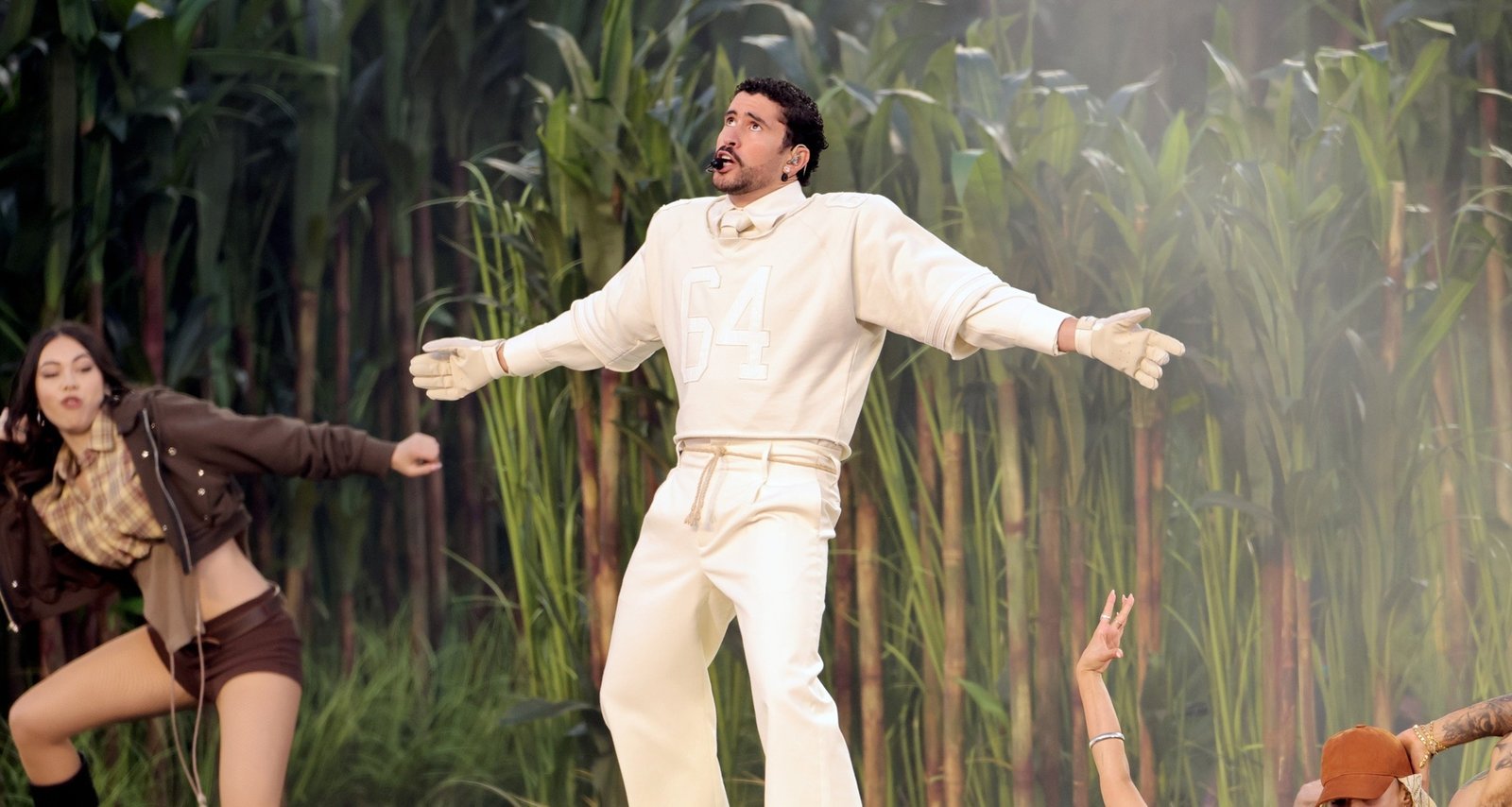
Imagem: Internet
Production elements further underscored that trajectory. The program blended reggaeton rhythms with arena-sized lighting, pyrotechnic bursts and an ensemble of dancers dressed in the headliner’s monochrome palette. Visual motifs—such as the rooftop breakaway and the market stall—provided narrative links to Puerto Rican life, while the use of bilingual stage banter kept the performance accessible to both English- and Spanish-speaking viewers.
Outside the stadium, advertisers capitalized on the attention. Apple Music promoted the show through city-wide digital billboards and a branded installation inside the Super Bowl LX Media Center. Streaming platforms reported elevated demand for Bad Bunny’s catalog in the week leading up to kickoff, suggesting a measurable commercial bump aligned with the halftime slot.
As fireworks concluded “DtMF,” the broadcast cut back to game coverage, ending a production that many industry observers view as a watershed for Latin music’s presence in U.S. pop culture. While long-term impact on future halftime bookings remains to be seen, Sunday’s event demonstrated that Spanish-language performance can anchor a spectacle designed for a global television audience without sacrificing cultural specificity.
Crédito da imagem: Neilson Barnard/Getty Images; Carlos Barria/Reuters; Mark J. Terrill/AP


