Broader market reaction
Losses were not isolated to Broadcom. Oracle shed 4.5% on Friday, extending the previous session’s 10% decline that followed its own earnings report. Nvidia, the leading supplier of graphics processing units for AI, fell about 3%, while Advanced Micro Devices slipped close to 5%. CoreWeave, a cloud provider specialising in AI data centers, dropped 10% and has now surrendered more than half of its market value since reaching a record high in June.
The weakness in AI-linked names weighed on the wider market: the Nasdaq Composite lost approximately 1.69%, and the S&P 500 declined around 1%. Both indexes remain heavily influenced by technology and chip stocks. (Background on the S&P 500’s composition can be found on S&P Global’s website.)
AI revenue momentum and margin pressure
Broadcom continues to lean on demand for custom silicon and networking chips tailored to artificial-intelligence systems. Sales of AI products grew 74% year over year in the latest quarter. Chief Executive Hock Tan told investors the company expects AI chip revenue to reach $8.2 billion this quarter, roughly double the amount recorded in the same period last year.
Even so, Chief Financial Officer Kirsten Spears cautioned that gross margin will be slimmer in the short term because building complete AI server systems requires purchasing more external components. For a company that historically emphasized high margins on core networking and storage semiconductors, the shift has heightened sensitivity among investors already wary of elevated valuations across the AI supply chain.
Order backlog and customer mix
Management disclosed an $73 billion backlog of committed AI business over the next 18 months. Approximately $21 billion of that total comes from Anthropic, an AI start-up scaling its cloud infrastructure. Orders from Alphabet’s Google, Meta Platforms and other hyperscale data-center operators also contribute significantly to the pipeline.
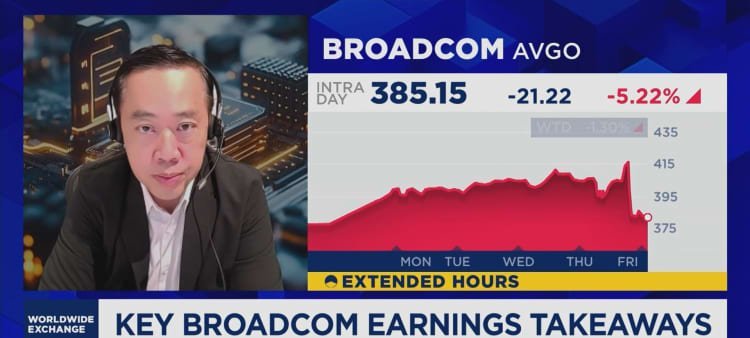
Imagem: Internet
Although OpenAI last year signed a multibillion-dollar agreement with Broadcom, Tan told analysts the relationship is unlikely to generate meaningful revenue in fiscal 2026, tempering assumptions that the partnership would provide a near-term earnings catalyst.
Analyst perspectives
Several research firms emphasized that the sharp decline in Broadcom’s share price reflects broader uncertainty rather than a deterioration in the company’s long-term outlook. Analysts noted that AI hardware spending remains robust, but margins could fluctuate as hyperscalers negotiate pricing and manufacturers contend with rising component costs. Some firms raised their price targets, arguing that recent weakness presents a buying opportunity, yet they acknowledged heightened volatility as investors reassess growth expectations across the sector.
Oracle’s parallel challenges
Oracle’s setback this week underscored similar concerns. While the company topped earnings estimates, revenue fell short, and the absence of detailed financing plans for its expanding cloud-computing footprint weighed on sentiment. The stock now trades more than 40% below the record high set in September, highlighting how quickly enthusiasm for AI-related spending can reverse when questions arise about profitability and capital requirements.
Sector outlook
AI investment has been a central theme for equity markets throughout 2025, fueling massive gains for semiconductor designers, equipment makers and cloud operators. With valuations elevated, any indication of slower growth, lower margins or higher debt loads has triggered swift share-price adjustments. Friday’s action reinforced that dynamic, suggesting investors may demand clearer visibility into cash flows and cost structures before pushing AI-centric stocks back toward recent highs.
For Broadcom, the immediate focus remains balancing rapid expansion in custom AI silicon with margin discipline. The company’s next earnings report will offer further insight into whether anticipated volume gains can offset cost pressures and validate management’s long-range forecasts.
Crédito da imagem: Lucas Jackson / Reuters


