Citi Sees Opportunity in the Pullback
Not all market participants view the post-earnings weakness as a threat. Citi senior analyst Jason Bazinet reiterated a “Buy” rating on Disney and kept a $140 price target in place. From the stock’s most recent trading level, that objective implies upside potential of more than 30%. Bazinet told financial media outlets that quarterly fluctuations in film budgets and promotional spending often distort near-term estimates and should not be mistaken for deterioration in the underlying business.
The analyst pointed to Disney’s ability to exceed consensus forecasts in the first quarter as evidence that the core operations remain resilient. He also highlighted the company’s price-to-earnings ratio, which sits near 14 on forecast profits. In Bazinet’s view, that multiple does not fully reflect the company’s prospects for double-digit earnings growth or the incremental revenue that management expects from its streaming initiatives.
Context for the Guidance Shortfall
During the call, executives emphasized that the timing of movie releases and associated advertising outlays can skew a single quarter’s profitability. That variability featured prominently in the outlook for the second quarter. While the company did not offer precise segment-level forecasts, it noted that theatrical releases scheduled for later in the fiscal year would concentrate certain costs in the first half. As a result, investors who rely heavily on quarter-to-quarter comparisons may encounter volatility in headline numbers.
Disney’s streaming portfolio, which includes Disney+, Hulu and ESPN+, remained a focal point for both bullish and bearish camps. Management reiterated its goal of reaching sustained profitability in direct-to-consumer services, a milestone that executives have said could arrive as early as fiscal 2027. Subscriber growth during the first quarter met internal targets, but the firm cautioned that competitive dynamics could influence net additions throughout the year.
Technical Landscape
The break below major moving averages has technical analysts debating whether the stock has entered an extended downtrend or merely a temporary consolidation. Historically, a decisive move beneath the 200-day average can attract short-term sellers and automated trading programs, adding to downward pressure. Conversely, fundamental investors sometimes view such episodes as opportunities to accumulate positions at discounted valuations.
According to data from Investopedia, crossing below a long-term average does not guarantee further weakness, but it often coincides with heightened volatility. For long-only managers, a key consideration is whether the company’s fundamental trajectory remains intact; if it does, technical weakness may serve as an entry point rather than a warning sign.
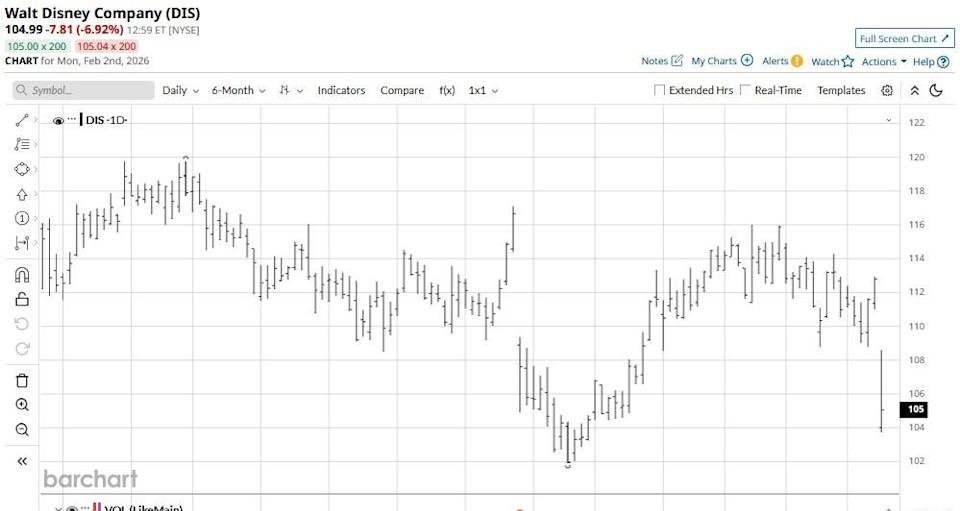
Imagem: Internet
Valuation, Dividend and Street Consensus
Disney currently offers a dividend yield of approximately 1.41%. While modest compared with high-payout sectors such as utilities, the distribution provides income-oriented investors with a tangible return while they wait for capital appreciation. Bazinet argued that the combination of a below-market earnings multiple and a resumed dividend program strengthens the investment case.
Broadly, Wall Street maintains a constructive stance on the stock. The consensus rating among firms tracked by major research aggregators stands at “Strong Buy,” and the average twelve-month price objective is about $135 per share—a projected gain of roughly 29% from recent levels. Those estimates incorporate assumptions of gradual improvement in streaming margins, incremental park attendance growth and a stable advertising environment.
Long-Term Considerations
Beyond quarterly earnings, Disney continues to invest in intellectual property, theme-park expansions and international distribution. Earlier filings with the U.S. Securities and Exchange Commission outline capital expenditure plans designed to reinforce competitive advantages across media and experiences segments. The company is also managing debt maturities with an eye toward preserving flexibility for potential acquisitions or strategic partnerships.
Nonetheless, risks remain. A prolonged slowdown in consumer spending, intensifying competition in streaming and fluctuations in foreign exchange rates could affect profitability. Additionally, regulatory scrutiny of media consolidation and data privacy practices may introduce unforeseen costs or delays in growth initiatives.
Outlook
For now, the market reaction reflects skepticism about Disney’s near-term earnings trajectory and the timeline for streaming profitability. Yet several analysts, led by Citi’s Bazinet, contend that the valuation already prices in those concerns while underappreciating longer-term catalysts. Whether that perspective gains traction may hinge on the company’s ability to demonstrate consistent margin expansion and deliver on content pipelines in the quarters ahead.
Investors weighing a position face a familiar calculus: balance short-term volatility, highlighted by the breach of significant technical thresholds, against the prospect of multi-year growth in streaming, parks and consumer products. The divergence of views ensures that trading volumes are likely to stay elevated as new information emerges. Until then, the debate over whether the current pullback represents risk or opportunity will remain a focal point on trading desks and in boardrooms alike.
Crédito da imagem: Barchart