The pressure on the system is mounting because air traffic controllers and Transportation Security Administration screeners are classified as essential employees. They have been working without pay since the shutdown began and are due to miss a second full paycheck on Monday. Union officials report that some controllers have taken temporary second jobs to cover household expenses.
Republican senators on Friday blocked a Democratic proposal to reopen the federal government, extending the stalemate that has already surpassed previous shutdown durations. Without congressional action, the FAA says flight cuts will continue to intensify.
Airports Affected by FAA Directive
The ordered reductions apply to the following airports:
ANC – Anchorage, ATL – Atlanta, BOS – Boston, BWI – Baltimore/Washington, CLT – Charlotte, CVG – Cincinnati/Northern Kentucky, DAL – Dallas Love, DCA – Washington National, DEN – Denver, DFW – Dallas/Fort Worth, DTW – Detroit, EWR – Newark, FLL – Fort Lauderdale, HNL – Honolulu, HOU – Houston Hobby, IAD – Washington Dulles, IAH – Houston Intercontinental, IND – Indianapolis, JFK – New York Kennedy, LAS – Las Vegas, LAX – Los Angeles, LGA – New York LaGuardia, MCO – Orlando, MDW – Chicago Midway, MEM – Memphis, MIA – Miami, MSP – Minneapolis/St. Paul, OAK – Oakland, ONT – Ontario (CA), ORD – Chicago O’Hare, PDX – Portland (OR), PHL – Philadelphia, PHX – Phoenix, SAN – San Diego, SDF – Louisville, SEA – Seattle/Tacoma, SFO – San Francisco, SLC – Salt Lake City, TEB – Teterboro, and TPA – Tampa.
Impact on Travelers and Airlines
The disruptions are unfolding during a traditionally quiet travel period; however, the Thanksgiving holiday, one of the busiest U.S. travel windows, begins in less than three weeks. Analysts at Seaport Research Partners estimate that the financial impact could quadruple during that peak week because fares typically rise sharply with demand.
Major carriers have waived change fees for passengers booked on flights subject to the FAA cuts and are offering refunds upon request. Airline representatives say most travelers are being rebooked on alternate departures, but last-minute adjustments have forced some customers to seek other arrangements. Rental car company Hertz reported a 20 percent year-over-year jump in one-way bookings during the two-day span following the FAA directive.
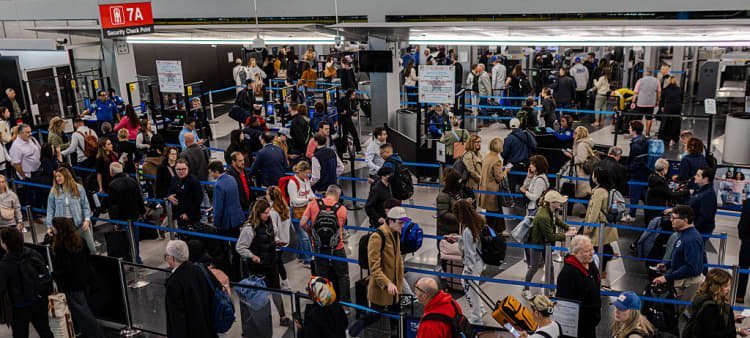
Imagem: Internet
Air traffic control staffing shortages created ground-stop or delay programs Saturday at Atlanta Hartsfield-Jackson, San Francisco International, New York Kennedy, Newark Liberty, Houston Intercontinental, and Chicago O’Hare, among others. Similar constraints are expected to persist as long as hiring, training and overtime decisions remain constrained by the budget freeze.
Operational Strain and Safety Concerns
Industry officials say the immediate challenge is balancing reduced staffing levels with the need to maintain safe separation between aircraft. The National Air Traffic Controllers Association has cautioned that extended overtime and fatigue could erode safety margins, though the union maintains it is not advocating work slowdowns. The FAA reiterated that safety standards will not be compromised, but acknowledged that throughput must be reduced to match available personnel.
Historically, even short periods of diminished air traffic control capacity have produced ripple effects across the network, delaying flights far from the initial bottleneck. The current directive aims to prevent uncontrolled gridlock by proactively removing flights from the timetable. Airlines retain discretion over which specific departures to cancel, but international routes have been largely exempt to preserve trade and long-haul connectivity.
For travelers, the best resource for real-time status updates remains the individual airline, though the FAA posts national delay information on its official website. Passengers booked through next week are advised to confirm itineraries frequently and arrive early at airports, as security check-point staffing faces the same financial pressures affecting control towers.
Unless lawmakers reach a budget agreement in the coming days, carriers will publish revised schedules reflecting the 10 percent reduction by Friday. Further rounds of cuts could follow, matching the secretary’s warning of up to 20 percent capacity reductions if the shutdown drags deeper into the holiday period.
Crédito da imagem: Bloomberg via Getty Images


