Local leaders have countered that description, noting that the federal government has not provided data showing a persistent pattern of violent crime committed by undocumented immigrants in the city. North Carolina Governor Josh Stein, a Democrat, issued a statement on Friday saying that law-enforcement resources should be aimed at violent criminals and drug traffickers, not at broad immigration sweeps. He encouraged residents to record any interaction they deem improper and to remain calm and cooperative while insisting on their legal rights.
Charlotte Mayor Vi Lyles, Mecklenburg County Board of Commissioners Chair Mark Jerrell, and Charlotte-Mecklenburg Schools Board Chair Stephanie Sneed released a joint message on Saturday asserting that all residents deserve to move about the city without fear. They emphasized that community members should still feel comfortable attending school, shopping for groceries, or commuting to work without concern that routine activities will lead to detention.
The Charlotte-Mecklenburg Police Department (CMPD) said it is not participating in the federal initiative and was not involved in its planning. In a written statement, CMPD reiterated that its officers do not execute administrative immigration warrants, which are civil rather than criminal in nature. The department added that it remains focused on local crime-reduction strategies and will continue to respond to calls for service without regard to immigration status.
Some residents reported multiple encounters with agents during the first day of the surge. Willy Aceituno, a naturalized U.S. citizen originally from Honduras, told local media that he was stopped twice on Saturday. During one interaction, agents allegedly broke a window of his vehicle before releasing him after he produced proof of citizenship. Accounts such as his have heightened concerns that lawful residents and citizens could be mistakenly detained during the operation.
As of Saturday evening, no significant clashes between federal officers and local law enforcement had been reported, and no serious injuries were confirmed. Nevertheless, civil-rights organizations said they were monitoring developments and advising individuals of their rights during encounters with immigration authorities. Advocates distributed bilingual “know your rights” cards and instructed residents to document any use of force or property damage.
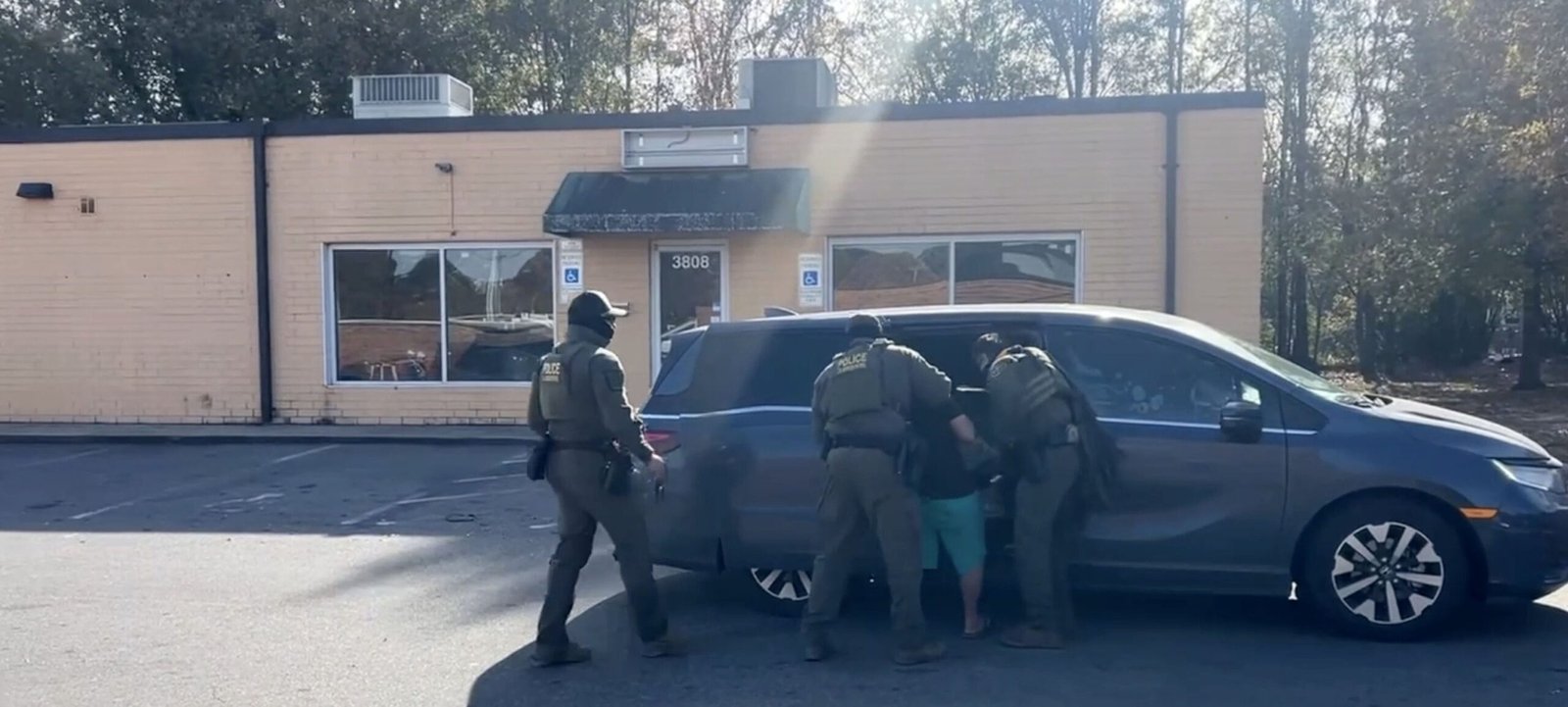
Imagem: Internet
The immigration action in Charlotte follows similar deployments in other U.S. cities over the past two years. DHS has previously sent teams to Chicago, Portland, and Philadelphia, asserting that local restrictions on cooperation with federal immigration agencies necessitate an enhanced federal presence. Background on the agency’s stated priorities can be found on the official DHS website, which outlines the criteria used to identify individuals targeted for removal (Department of Homeland Security).
Officials in Asheville, located about 120 miles west of Charlotte, said Saturday that their city could also become a focus of future operations. Mayor Esther Manheimer stated that local authorities have received indications of possible Immigration and Customs Enforcement activity and will monitor developments closely. She echoed concerns raised in Charlotte, saying every resident, regardless of immigration status, should feel safe in the place they call home.
Federal authorities have not disclosed how long the Charlotte deployment will last or how many individuals they plan to arrest. DHS has also declined to specify what criteria agents are using to select targets beyond stating they are looking for persons who pose “public-safety threats.” Local leaders have requested regular briefings and data on arrests, but it remains unclear whether such information will be shared while the operation is underway.
For now, the presence of federal personnel continues to generate tension between state and local governments and the Trump administration. While Charlotte officials reiterate that their police force will not participate in civil immigration enforcement, DHS maintains that it has the legal authority to operate anywhere in the United States. Residents, meanwhile, are left navigating increased law-enforcement activity as the operation proceeds into its second week.
Crédito da imagem: WSOC / Paula Walker Coleman


