Prices climb at record speed
Research firm TrendForce forecasts that average DRAM contract prices will rise 50 to 55 percent in the current quarter compared with the fourth quarter of 2025. Analyst Tom Hsu described the increase as “unprecedented,” attributing it to limited supply of high-performance memory reserved for data-center customers. Earlier this month, Micron announced it would exit a business segment that sold memory modules to hobbyist PC builders, freeing capacity for server-class components.
Retail indications match the trend. Juice Labs co-founder Dean Beeler wrote on social media that the 256 GB of RAM he purchased for roughly $300 a few months ago would now cost around $3,000, reflecting the speed at which consumer pricing has shifted.
Why AI accelerators need more memory
Modern AI chips surround a graphics processing unit (GPU) with blocks of high-bandwidth memory (HBM) that deliver far greater data throughput than conventional laptop or smartphone RAM. Nvidia’s new Rubin GPU, now in production, supports up to 288 GB of HBM4 and will be packaged into the NVL72 server platform, which integrates 72 GPUs in a single rack. Smartphones, by contrast, typically ship with 8 GB to 12 GB of lower-powered DDR memory.
HBM is manufactured by stacking 12 to 16 layers of silicon, forming what Sadana calls a “cube.” Because the process is complex and wafer space is finite, Micron estimates that producing one bit of HBM forces the company to give up manufacturing capacity for three bits of standard DRAM. Sadana said that constraint directly reduces supply for laptops, desktops and other consumer devices.
Impact on downstream manufacturers
Laptop makers are already bracing for higher component expenses. TrendForce calculates that memory now represents about 20 percent of total laptop hardware cost, up from 10-18 percent during the first half of 2025. During recent earnings calls, Apple executives referred to only a “slight tailwind” in memory pricing, while Dell Technologies warned that it expects overall product costs to rise. Dell Chief Operating Officer Jeff Clarke told analysts the company would adjust configurations to soften the blow but predicted that higher memory expenses will eventually reach end-users.
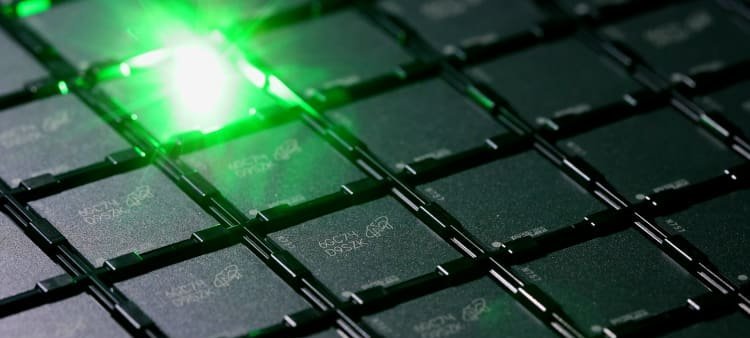
Imagem: Internet
Even the largest buyers are feeling the pinch. At a CES press conference, Nvidia CEO Jensen Huang acknowledged concerns that rising DRAM costs could affect gaming graphics cards, noting that additional fabrication plants will be necessary to meet industry requirements.
Expansion plans and persistent gaps
Micron is constructing two fabrication facilities in Boise, Idaho, slated to begin production in 2027 and 2028, and intends to break ground on another plant in Clay, New York, targeted for 2030. Despite those projects, Sadana said current output is already “sold out for 2026,” and in the medium term the company may be able to satisfy only two-thirds of customer demand.
Supply constraints are influencing technical design choices. Start-up Majestic Labs, for example, is building an inference platform with 128 terabytes of memory—roughly 100 times more RAM than typical AI servers—while avoiding HBM in favor of cheaper alternatives. Co-founder Sha Rabii said limited memory bandwidth, often called the “memory wall,” has become a primary bottleneck for large language models, and additional capacity can permit larger context windows and serve more users per system.
Analysts expect the imbalance to persist until new fabs become operational. A briefing from the Semiconductor Industry Association notes that advanced memory plants typically take several years and billions of dollars to build, underscoring why near-term relief is unlikely.
For now, both consumer electronics producers and data-center operators face escalating costs as AI workloads claim a growing share of the world’s DRAM output. With orders already booked through 2026 and large-scale expansions years away, pricing pressure appears set to continue.
Crédito da imagem: Eugene Mymrin | Moment | Getty Images


