Europe: Sector Index Extends Losses
European software shares followed the U.S. move. The Stoxx Europe Software and Computer Services index fell more than 5% on Tuesday. British analytics firm RELX shed over 14%, and French IT services group Capgemini lost 9.2% by the closing bell. Selling resumed on Wednesday: by midday, the regional software index was down an additional 1.9%.
Among individual movers, Dutch navigation specialist TomTom slumped 12.5%. Danish-founded review platform Trustpilot dropped more than 7%, while German workforce-management developer Atoss fell 6.4%.
Asia: Japanese and Indian Names Under Pressure
During the Asian session, Japanese software companies led declines. IT services provider TIS plunged almost 16%. Cyber-security group Trend Micro lost more than 7%, and NS Solutions shed a similar amount.
Indian technology shares, which had outperformed on Tuesday after the country announced a trade deal with the United States, also reversed course. The Nifty IT index fell 5.8%. Tata Consultancy Services and Infosys dropped 7% and 7.3%, respectively, while HCL Technologies slipped 4.3%.
In China, Kingdee International Software fell more than 12%. Major cloud provider Tencent lost 4%, while Alibaba and Baidu were down close to 1% and 3%, respectively.
Drivers: AI-Related Competitive Threats
Market participants cited growing anxiety that generative AI tools could automate tasks traditionally handled by enterprise software suites, putting pressure on pricing and opening the door for new entrants. On Tuesday, AI research company Anthropic released enhanced features for its Cowork platform, reinforcing expectations of faster product cycles across the sector.
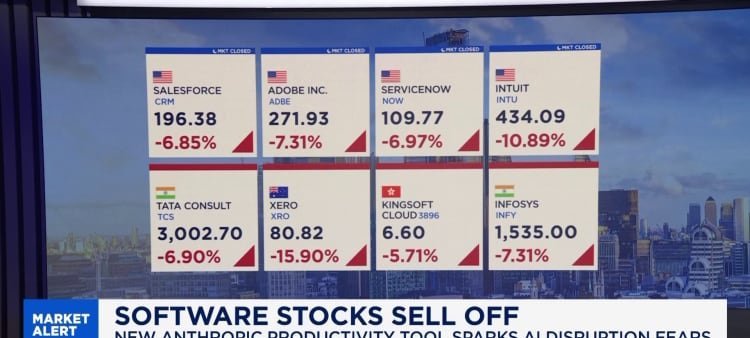
Imagem: Internet
Ed Yardeni, president of Yardeni Research, said the technology landscape has become markedly more competitive as a result of AI breakthroughs, prompting investors to revisit earnings assumptions and valuation multiples for software providers.
Sector View: Differing Risk Profiles
Vey-Sern Ling, senior equity adviser at Union Bancaire Privée, noted that companies must demonstrate AI can boost growth rather than merely threaten existing franchises for the sector to regain momentum. Ling added that infrastructure software faces lower disruption risk than applications aimed at end users, while cyber-security vendors may benefit from pricing power and opportunities to incorporate AI-driven upgrades.
Market Context
Software firms have historically commanded premium valuations, supported by recurring subscription fees and high customer retention. The latest AI-driven sell-off highlights investor sensitivity to any narrative that challenges that model. Although many companies have outlined plans to embed AI into their offerings, investors appear skeptical about the timing and scale of incremental revenue.
The retreat also underscores how quickly sentiment can shift in technology shares. After a strong run in 2023 and early 2024, many of the same companies are now among the year’s worst performers, even as broader equity benchmarks remain close to record levels.
Analysts pointed out that the reset could create an opportunity for firms able to prove tangible AI-related productivity gains or new revenue streams. Until then, volatility is likely to persist as the market searches for evidence that artificial intelligence will add, rather than subtract, value for established software leaders.
Crédito da imagem: Kmatta | Moment | Getty Images