GM’s Product Chief Reshapes Technology Strategy Amid Executive Turnover - Trance Living

GM’s Product Chief Reshapes Technology Strategy Amid Executive Turnover

Sterling Anderson, who became General Motors’ executive vice president and chief product officer in June, is consolidating control over vehicle development, manufacturing engineering, battery programs, software and related services after six months on the job. The former Tesla executive and Aurora Innovation co-founder now oversees what GM describes as the “end-to-end product lifecycle,” an expanded remit that follows the departure of three high-profile software and artificial-intelligence leaders in recent weeks.

Dave Richardson, senior vice president of software and services engineering, and Barak Turovsky, head of artificial intelligence, left the company abruptly as part of a restructuring aimed at embedding AI functions directly into product teams, according to a GM spokesperson. Baris Cetinok, senior vice president of software and services product management, is scheduled to exit on Dec. 12 for an external opportunity, people familiar with the matter said. Richardson and Cetinok joined the automaker in 2023, while Turovsky arrived in March.

The leadership changes underscore Anderson’s goal of eliminating what he calls the historical separation between hardware and software inside GM. Speaking at the “GM Forward” technology showcase in New York on Oct. 22, he said accelerating innovation depends on “disaggregation” of software from hardware and unifying previously distinct groups under a single product organization. Anderson spent his first five months in what he termed “listen mode,” examining operations across design, engineering, manufacturing and digital services before outlining his strategy.
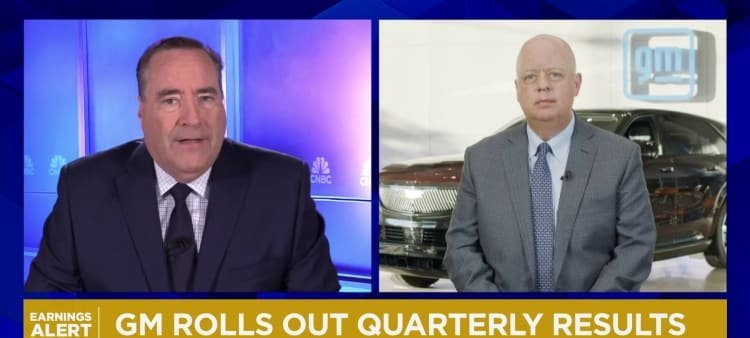
Chief Executive Officer Mary Barra and President Mark Reuss recruited Anderson to re-energize GM’s push into software-defined vehicles and automated driving. Barra reiterated the company’s objective during The New York Times DealBook Summit on Dec. 3, saying GM is “well positioned” to introduce autonomous highway driving capability starting in 2028. She cited Anderson’s expertise and the company’s years of autonomous-vehicle research as foundations for the plan.

Anderson, 42, holds master’s and doctoral degrees in robotics from the Massachusetts Institute of Technology and previously led Tesla’s Model X program as well as the team that launched the automaker’s first “Autopilot” driver-assistance features. At MIT he helped develop the “Intelligent Co-Pilot,” a semi-autonomous safety system. After leaving Tesla, he co-founded Aurora Innovation in 2017 and spent six years building the self-driving startup before deciding earlier this year to join GM—a move he said required “several conversations” because he once assumed he would remain at Aurora for the rest of his career.

The Detroit automaker has hired several high-profile technology executives from Silicon Valley in recent years but has struggled to retain them for long periods. Consultants note that traditional manufacturers often underestimate the cultural adjustments and time frames required to merge software-centric practices with decades-old vehicle-development processes. Peter Abowd of Envorso, an engineering consultancy, said executives face “overwhelming responsibilities” inside large legacy organizations and frequently depart before transformative changes can take hold.

GM’s Product Chief Reshapes Technology Strategy Amid Executive Turnover - Imagem do artigo original

Imagem: Internet

GM’s technology ambitions extend beyond automated driving. The company continues to invest in electric-vehicle batteries, digital services and over-the-air software updates modeled on systems pioneered by Tesla. The shift requires integrating advanced electronics throughout design and production lines—a challenge all global carmakers face. The U.S. National Highway Traffic Safety Administration, for example, outlines six levels of automation that automakers must navigate as they commercialize new driver-assistance systems (nhtsa.gov).

Reuss retains oversight of manufacturing, design, marketing and sales, while Anderson’s new product organization handles the technical core of future models. GM describes the realignment as essential to speeding decision-making and matching the pace of pure-play technology firms. Anderson has compared GM to a “canvas” that can be curated or reworked, saying the company’s scale—combined with methodologies he learned at Tesla and Aurora—creates “an extraordinary opportunity for innovation.”

Crédito da imagem: GM

You Are Here: