For full-year 2025, revenue declined 10 percent to €14.7 billion. Recurring operating income fell 33 percent, and the operating margin narrowed to 11.5 percent amid softer sales and higher costs.
New leadership confronts slowdown
De Meo, who joined Kering in 2024 after steering automaker Renault through a turnaround, reviewed results on his first earnings call as chief executive. “2025 was not the year we wanted,” he told analysts, acknowledging that performance “didn’t reflect the full potential of Kering.” He added that the group has been taking “decisive action” since the second half of the year to restore growth and profitability.
Among those actions is a balance-sheet restructuring. In January, Kering agreed to sell its beauty division to L’Oréal for €4 billion, a move aimed at reducing net debt and allowing management to concentrate on core fashion operations. De Meo is also refining the company’s brand architecture and product strategy on what he described as a “house by house, product by product, client by client” basis.
Focus on Gucci
The most urgent task is to reinvigorate Gucci, which has lagged larger rival Louis Vuitton and newer stars such as Dior in recent quarters. The brand has struggled with pricing decisions made during the post-pandemic boom and with weakened demand in China, formerly its most powerful growth engine. Kering appointed designer Sabato De Sarno as Gucci’s creative director, and his debut collection, “La Famiglia,” reached stores last year. Management hopes the line will gradually restore the brand’s momentum, though the company said significant progress is more likely in 2026.
Sector headwinds
Kering’s challenges are not unique. The broader luxury industry has slowed after a sharp post-Covid expansion, and higher prices have alienated some aspirational shoppers. A cautious consumer mood in China, macroeconomic uncertainty in Europe and a normalization of spending in the United States have also weighed on demand. According to a Reuters overview of the sector, several global luxury houses have warned of muted sales trends heading into 2024.
Outlook and next steps
Kering expects to return to top-line growth and to improve margins in 2026, though executives refrained from offering detailed numeric guidance. A comprehensive strategic update is scheduled for the company’s Capital Markets Day in April, when de Meo plans to elaborate on brand-specific initiatives, cost-saving opportunities and capital allocation priorities.
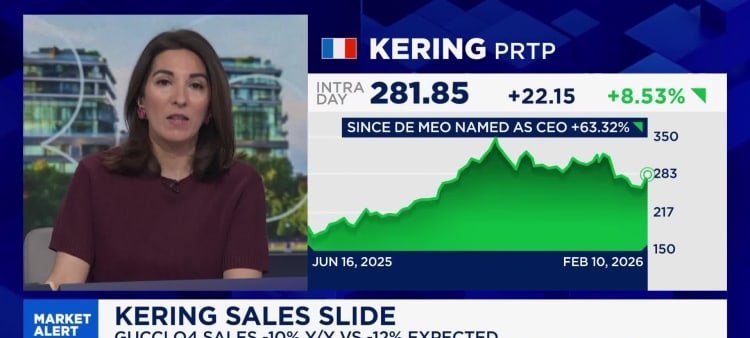
Imagem: Internet
The CEO hinted at further diversification, noting that Kering is preparing to enter the wellness and longevity market, which he described as “a space where we want to play and where we know value and growth will be created.” He also signaled that a refreshed jewelry strategy will be unveiled at the April event.
Investor reception
Analysts largely welcomed the fourth-quarter figures and the new leadership’s early measures. Bernstein’s Luca Solca called the results “a slight improvement across the board,” but said the key debate is whether Gucci can return to growth in fiscal 2026, as current consensus projects. Jefferies analyst James Grzinic pointed to “gradually reducing pressures” and highlighted cost-savings potential as an area investors will scrutinize.
More immediately, the modest revenue beat and clear messaging on deleveraging appeared sufficient to spark a relief rally. Kering’s shares are still trading well below their 2021 highs, underscoring how much progress stakeholders will want to see before confidence in a sustained turnaround is fully restored.
Competitive landscape
Within the luxury peer group, market leaders such as LVMH have weathered the slowdown better, supported by a broader brand mix and scale advantages. Smaller specialists like Brunello Cucinelli, with its focus on cashmere and high-end ready-to-wear, have continued to post growth by targeting niche segments. Kering’s task is to reposition Gucci and its other houses to compete effectively in an environment where branding, craftsmanship, sustainability and customer experience are increasingly decisive.
Key figures
- Fourth-quarter revenue: €3.9 billion, down 3 percent comparable.
- Gucci revenue: down 10 percent comparable.
- Full-year 2025 revenue: €14.7 billion, down 10 percent.
- Recurring operating income: down 33 percent year on year.
- Operating margin: 11.5 percent.
- Beauty division sale: €4 billion proceeds.
- Share price move: +14 percent intraday, +10 percent last quoted; –14 percent year to date before today.
What to watch
The market will focus on several forthcoming milestones: the sales trajectory of Gucci’s new collections in 2024, the April Capital Markets Day for quantitative guidance, the deployment of proceeds from the beauty unit divestiture, and early indicators of progress in the wellness and jewelry segments. Execution against those benchmarks will determine whether Tuesday’s share-price rebound marks the beginning of a broader re-rating or merely a temporary reprieve.
Crédito da imagem: Future Publishing via Getty Images