
Micron Technology shares rallied sharply in midday trading on April 27, adding more than 5 percent after a series of unusually large option trades and fresh upward revisions to the chipmaker’s revenue outlook. The stock changed hands at $523.35 shortly after noon in New York, extending a rebound that began late last month when the price touched a recent low of $321.80. The latest advance lifted Micron’s market capitalization to approximately $590.5 billion, while several valuation models point to additional room for appreciation.
Analysts attribute the renewed enthusiasm to the company’s March 18 earnings release, during which executives highlighted accelerating demand for memory products used in artificial-intelligence applications. Since that call, Wall Street research firms have continued to boost their sales projections, a development underscored in a survey of 35 analysts compiled by Seeking Alpha. The consensus now calls for $108.91 billion in revenue for the fiscal year ending August 2026 and $169.13 billion for fiscal 2027. On a next-twelve-months basis, expected revenue stands near $139 billion.
The top-line revisions feed directly into estimates for free cash flow, the metric many investors consider the best single gauge of corporate value. In the first six months of Micron’s current fiscal year, the company converted 28.8 percent of adjusted revenue into free cash, or roughly $10.8 billion on sales of $37.5 billion. Applying the same margin to the next-twelve-months revenue estimate yields a prospective adjusted free cash flow figure close to $40 billion.
Using that cash flow outlook, some equity strategists now assign Micron a market-value target that exceeds the current capitalization by a wide margin. A frequently cited approach assumes investors will pay 17.5 times adjusted free cash flow, a valuation multiple broadly in line with large-cap semiconductor peers. On that basis, Micron’s theoretical market value would reach roughly $700 billion, implying an 18.5 percent upside to about $620 per share from the latest trade.
While fundamental projections have grown more optimistic, the derivatives market also reflects heightened interest. Data published by Barchart highlight an unusual spike in option volume tied to Micron, with heavy activity clustering in contracts that expire over the coming two years. Elevated demand for bullish call options frequently indicates that institutional investors are positioning for continued price gains, although sharp movements in implied volatility can equally expose holders to larger-than-normal swings.
Current analyst price targets remain below the most aggressive free-cash-flow scenarios but have nonetheless trended higher. According to Yahoo Finance, the average target among 42 analysts now sits at $533.72, while Barchart places the mean estimate at $546.09. Those numbers compare with the stock’s level near $523 at midday, suggesting moderate appreciation potential under consensus assumptions. For perspective, official company filings available through the U.S. Securities and Exchange Commission show Micron ended its most recent quarter with ample liquidity and declining net debt, factors that can bolster confidence in sustained free-cash-flow generation.
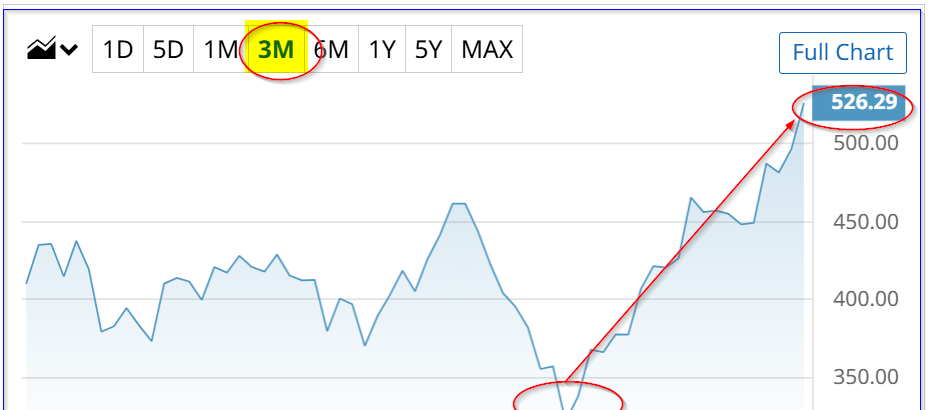
Imagem: Internet
Micron’s rise has coincided with a broader rally in semiconductor equities, particularly those tied to artificial-intelligence infrastructure. Investor sentiment toward the group improved markedly after several large technology platforms disclosed multiyear spending plans aimed at expanding data-center capacity. Memory suppliers stand to benefit as next-generation servers require higher-performance dynamic random-access memory (DRAM) and larger solid-state storage units, both areas where Micron maintains significant market share.
The stock’s rebound has been brisk. From the March 30 trough of $321.80 to the midday quote above $523, the shares have advanced nearly 63 percent in less than a month. Over the same interval, Micron posted its fiscal-second-quarter results and reiterated expectations that industry supply conditions will tighten through calendar 2026, supporting pricing momentum. Management further indicated that capital-expenditure discipline across the memory sector should keep inventories in check, an assertion many analysts cite when explaining their upgraded forecasts.
Despite the positive backdrop, several variables could influence the trajectory of Micron’s valuation. Shifts in global economic growth, foreign-exchange dynamics and competitive behavior among memory producers have historically driven pronounced earnings volatility. In addition, ongoing geopolitical tensions affecting high-technology supply chains may alter demand patterns or restrict access to certain end-markets. Investors considering positions in Micron options or common stock therefore continue to monitor regulatory developments and macroeconomic indicators closely.
For now, trading desks appear focused on the immediate catalysts of option activity and upcoming corporate events. The company has scheduled its next set of financial disclosures for late June, when additional color on capital spending, inventory levels and customer purchase commitments could either reinforce or temper the prevailing bullish outlook. Until then, the combination of surging analyst estimates, strong free-cash-flow metrics and heightened derivatives interest is keeping Micron in the spotlight of both equity and options markets.