The 41-year-old aerospace executive is best known for commanding a 2021 private orbital flight aboard SpaceX’s Crew Dragon, becoming one of the first nonprofessional astronauts to orbit Earth. His hands-on experience in commercial spaceflight has shaped his vision for NASA, which centers on partnering with private industry to reduce costs and speed development.
Isaacman said the space agency will rely heavily on its multicontractor Artemis campaign, designed to reestablish a human presence on the Moon and lay groundwork for eventual missions to Mars. NASA is collaborating with SpaceX, Blue Origin and Boeing on various components of the program. Artemis II, the first crewed test of the Space Launch System rocket and Orion spacecraft, is slated to launch in the near future, while Artemis III will use a SpaceX-built lunar lander to deliver astronauts to the surface.
Advances in heavy-lift launch vehicles and in-orbit cryogenic propellant transfers are expected to play a pivotal role. Both SpaceX and Blue Origin are refining reusable rockets capable of delivering large payloads to cislunar space and returning safely to Earth. Isaacman argued that routine, cost-effective transportation will be essential for establishing permanent outposts and enabling frequent crew rotations. He said such technologies will “allow us to travel between Earth and the Moon regularly and lay the foundation for Mars expeditions and beyond.”
The administrator outlined several economic opportunities that a sustained lunar presence could unlock. Potential projects include data centers that harness the Moon’s stable thermal environment, construction of power and communications infrastructure, and extraction of resources such as helium-3, a rare isotope embedded in lunar regolith that scientists view as a promising fuel for future fusion reactors. Isaacman added that once a permanent base is operational, NASA plans to explore investments in small modular nuclear reactors and space-based nuclear propulsion to extend human reach deeper into the solar system.
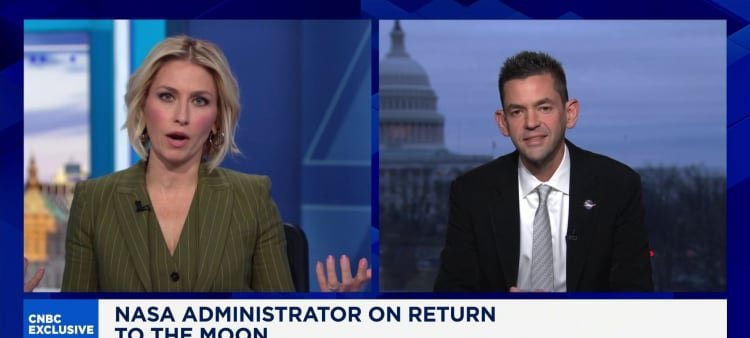
Imagem: Internet
Congress bolstered those ambitions earlier this year by passing the One Big Beautiful Bill Act, which earmarked $9.9 billion for NASA. The extra funding supports Artemis hardware development, technology demonstrations and commercial partnerships. Isaacman emphasized that the agency intends to meet aggressive milestones despite budgetary pressures, relying on collaboration with the private sector to share costs and accelerate timelines.
Beyond the immediate goal of landing astronauts near the lunar south pole, NASA views the Artemis architecture as a testbed for long-duration life-support systems, radiation shielding and surface mobility platforms required for future Mars crews. The administrator said the experience gained from operating on the Moon will inform mission designs, risk management strategies and international norms for planetary exploration.
Details on launch dates remain fluid, but Isaacman reiterated that the agency is committed to achieving a crewed landing before January 2029, when Trump’s second term would conclude. Meeting that deadline, he noted, will depend on the readiness of hardware, the success of upcoming test flights and sustained political support.
Additional background on the Artemis program is available through the NASA website, which provides updates on mission objectives, hardware status and timelines in its Artemis overview.
Crédito da imagem: CNBC


