
A24’s forthcoming horror feature “Backrooms” has pushed the concept of liminal spaces—corridors, vacant malls and other transitional environments—into mainstream conversation. While the film dramatizes these zones as endless, unsettling mazes, recent research indicates that the unease they provoke reflects fundamental properties of human memory and spatial navigation. Neuroscientists say our brains rely on physical boundaries to mark where one experience ends and the next begins. When those boundaries blur or seem to stretch indefinitely, uncertainty rises, attention narrows and anxiety can spike.
The Brain’s Dependence on Boundaries
Liminal areas serve as connective tissue in architecture: hallways, stairwells, vestibules and waiting zones can occupy up to a third of a building’s floor plan. They are rarely destinations in themselves; instead, they separate more goal-driven or emotionally charged spaces such as offices, classrooms or bedrooms. Studies of the so-called “Doorway Effect” demonstrate how these partitions influence cognition. When a person walks through a doorway, the brain updates its contextual model, which can disrupt recall of objects or intentions formed in the previous room. Researchers at the University of Notre Dame found that crossing a threshold made participants more likely to forget an item they had just picked up, compared with walking the same distance inside a single room.
This mechanism is efficient under normal conditions, allowing the hippocampus and related structures to file memories by location, time and emotional relevance. Trouble arises when a boundary fails to signal a clear transition. If two adjoining rooms share near-identical lighting, color and layout, the brain struggles to determine where one episode should end. That ambiguity can bleed into memory itself, causing events to blend together.
Why the “Backrooms” Scenario Feels So Disturbing
The “Backrooms,” a viral internet myth now adapted by A24, exaggerates liminality to the point of dread. Characters wander through fluorescent-lit hallways that appear interchangeable, with doors, corridors and junctions repeating in seemingly infinite permutations. Because the scenery offers few unique cues—no windows, clocks or landmarks—the brain cannot assemble a reliable mental map. Instead of pausing to reflect, the navigator remains in constant scan mode, primed for potential threats from every direction. The longer the uncertainty lasts, the more exhausting and frightening the experience becomes.
Modern urban patterns have unintentionally created real-world parallels. Over the past two decades, property developers often found it cheaper to abandon malls or big-box retail buildings than to retrofit them. Entire neighborhoods, designed for a specific commercial era, now sit half-vacant, awaiting demolition or repurposing. These structures exist in temporal limbo: no longer thriving, yet not officially obsolete. For adolescents and young adults already negotiating the passage from childhood to adulthood, such settings can reinforce a sense of being “stuck in between.”
Context Cues Lower Uncertainty
During any transition, the brain engages in scenario planning—predicting what lies ahead and selecting the safest or most rewarding path. Stable environmental markers help orient that process. Signage, changes in flooring material, daylight access and even ambient sound give clues about direction, purpose and duration. In a minimalist environment with repetitive design, those signals vanish. Navigating a multilevel parking garage where every floor looks identical can be as disorienting as the fictional Backrooms. Without reference points, tasks that should be routine—finding the exit or recalling where a car is parked—become cognitively taxing.
The National Institute of Mental Health notes that persistent uncertainty can heighten stress responses, contributing to anxiety disorders and impaired decision-making (NIMH). While a horror film leverages that tension for entertainment, real-life architecture can either amplify or alleviate it.
The Role of Pause in Healthy Transition
Research on “wakeful rest” suggests that brief periods of non-task-oriented pause allow the brain to consolidate memories and integrate new information. Architect and theorist Miriam Hoffman argues that introducing places of deliberate rest—such as a bench at a crossroads—invites occupants to shift from active scanning to reflective processing. In museums, for instance, interstitial lounges and quiet galleries give visitors space to digest emotionally intense exhibits before proceeding. The United States Holocaust Memorial Museum in Washington, D.C., designed by James Ingo Freed, employs this strategy through its Great Hall and auxiliary seating areas.
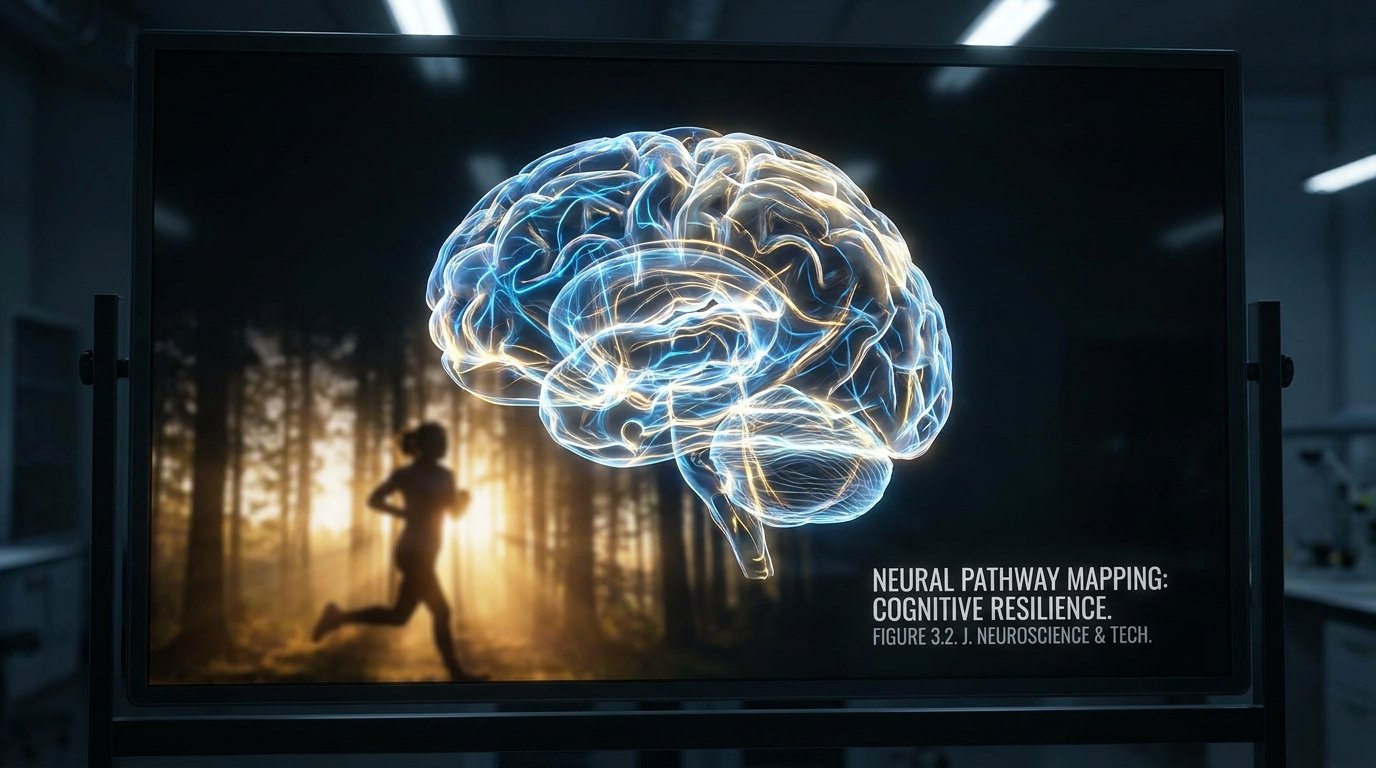
Imagem: exercise and brain health
When liminal spaces encourage lingering rather than rushing, they transform from zones of tension into buffers that facilitate psychological adjustment. A well-placed window, a change in ceiling height or a pocket of natural light can reassure users that the environment is stable and navigable.
Design Strategies for a Transition-Heavy World
Social, technological and economic changes are propelling many communities into overlapping phases of uncertainty. Architects, urban planners and employers are therefore examining how physical settings can promote resilience. Emerging recommendations include:
- Reducing the number of simultaneous decision points—such as multiple branching corridors—to limit cognitive overload.
- Increasing “global” visibility, for example through sightlines to the outdoors, clear signage or distinctive color coding for different zones.
- Embedding micro-pauses: alcoves, seating niches or landscaped pockets where occupants can momentarily disengage from goal-oriented movement.
These principles echo findings from spatial cognition studies showing that the hippocampus not only tracks location but also replays past routes during rest, a process believed to aid in future planning. When environments support that neural replay—by providing safe, stimulus-balanced refuges—they may help individuals cope more effectively with personal and societal transitions.
Implications Beyond Architecture
Because the same neural circuits interpret both physical boundaries and life events, insights from liminal-space design could inform broader transition management. Schools scheduling breaks between classes, employers creating decompression zones in offices or healthcare facilities offering calm waiting rooms all apply similar logic: give the brain enough information to feel oriented, plus moments to process change before the next demand.
As “Backrooms” reaches theaters, audiences may leave contemplating not only fictional horrors but also the real-world environments that shape everyday emotion. Liminal spaces need not be traps; with deliberate cues and opportunities for rest, they can function as guides through uncertainty, fostering adaptation rather than fear.