
Countless people report waking in the early hours with racing thoughts that feel both urgent and overwhelming. In a recent first-person account, essayist Selim Hayder describes lying awake at 3 a.m., convinced a routine headache signals a fatal illness, certain a next-day presentation will ruin a career, and fearing an unanswered text message means a friendship has ended. The narrative offers a detailed look at how everyday concerns can expand into perceived catastrophes during the night.
Hayder’s description follows a pattern familiar to many: the absence of an immediate crisis does little to calm a mind that insists danger is imminent once darkness falls. According to the essay, this late-night turmoil is not evidence of psychological malfunction. Instead, it reflects the brain’s evolutionary design. For most of human history, nighttime posed real threats from predators or rival groups. Individuals who stayed vigilant after sunset survived to pass on their genes, embedding a nocturnal alarm system that continues to scan for danger long after physical risks have diminished.
In modern settings, the brain still searches for threats, but the hazards have changed. When no predator is present, it targets what Hayder calls “new lions”: a mild physical symptom, an upcoming work obligation, or social silence on a messaging app. Once a candidate threat is identified, the brain escalates the scenario, presenting it as a certainty rather than a possibility. Minor discomfort becomes a life-ending illness, and a single unreturned message becomes proof of social rejection. The process unfolds quickly and with what the writer terms “zero mercy,” leaving the individual trapped in an imagined emergency.
Physiological reactions reinforce the illusion. The account notes a racing heart, cold hands, and a tight stomach—physical cues identical to those produced by genuine danger. The same mechanism appears in everyday experiments; visualizing a sour lemon can trigger salivation even though no fruit is present. At 3 a.m., adrenaline and cortisol surge in response to mental images alone, consuming energy that leaves the body fatigued by morning even when nothing tangible has happened.
Hayder observes that most feared scenarios never materialize, while real challenges often arise from directions the brain failed to monitor. Attempting to defeat the anxiety—through breathing exercises, counting routines, or guided meditations—sometimes offers temporary relief but can also intensify exhaustion by framing the mind as an adversary that must be subdued.
The writer reports progress after adopting an alternative strategy: acknowledgement without resistance. When a catastrophic thought surfaces, it is met with a calm internal response such as “That is a frightening possibility; we will see if it remains true in daylight.” This stance treats the anxious mind like a concerned companion whose warnings are heard but not necessarily believed. The approach creates what Hayder labels a narrow “gap” between the self and the unfolding narrative, allowing observation rather than full immersion.
Another practical step involves focusing on present conditions. In the quiet of a dark, locked room, the immediate reality is safety. The future, with all its imagined disasters, exists only as projection, and the past survives only as memory. By repeatedly anchoring attention to the current moment, the individual gains breathing room until sunrise, when perspective often returns and the previous night’s certainties dissolve.
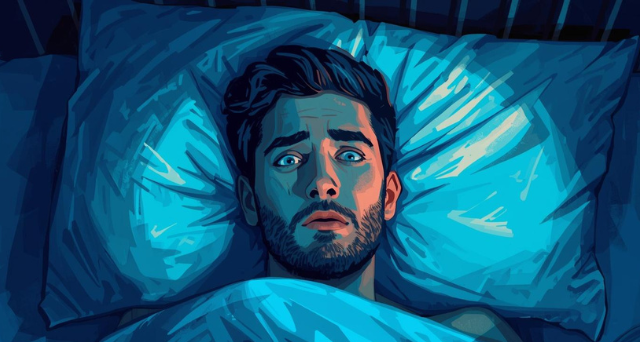
Imagem: Internet
The essay concludes that the brain’s nocturnal vigilance represents an archaic form of love rather than hostility. It attempts to protect its owner using an outdated template, unaware that the external dangers it was built to confront have largely disappeared. Understanding this intent can replace self-criticism with measured compassion, even while the thought storms continue to arrive.
Morning eventually exposes the mismatch between night fears and daylight realities: the presumed tumor reverts to an ordinary headache, the feared professional collapse becomes another workday, and the silent friend replies with a casual explanation. Recognizing this pattern does not eliminate anxiety, but it can reduce its authority, reminding those awake in the predawn hours that their experience is not evidence of brokenness—only of humanity.
For readers seeking additional context about the physiology and treatment of anxiety, an overview is available from the National Institute of Mental Health.
Hayder’s reflection ultimately frames 3 a.m. spirals as an inherited survival strategy working overtime in a safer world. By observing, acknowledging, and waiting for daylight, individuals may find enough distance to navigate the night without surrendering to every imagined disaster.