Initial Assessment and Coordination
According to departmental protocol, the crew contacted the New York State Department of Environmental Conservation (DEC) as soon as it became clear the animal was a bald eagle. Officers explained the circumstances, sent photographs via mobile phone and received authorization to attempt a retrieval.
Russo, a 16-year veteran with extensive experience assisting distressed boaters and even domestic animals, said this was the first time he had been involved in a rescue that featured a bird of prey. “Standard training covers many scenarios on the water,” he noted, “but handling a bald eagle is not covered in the manual.”
Executing the Rescue
With DEC guidance and information sourced from a wildlife handling reference, the crew devised a plan. A long-handled catch noose normally reserved for smaller animals was selected to limit wing movement and prevent the bird from injuring itself or the responding officers. As the vessel edged toward the eagle’s ice floe, officers observed that the raptor was wet, bleeding and vocalizing loudly, yet made no attempt to fly away.
Sergeant Michael Amello positioned himself at the bow, looped the noose around the eagle’s torso and drew its wings gently alongside its body. Once the bird was restrained, Amello placed a dark cloth over its head to reduce visual stimuli, a common calming technique used in wildlife rescue.
Detective Nicholas Martin assisted in lifting the approximately 10-pound eagle onto a padded surface on the deck. Martin later told reporters that the bird’s talons, which can exceed two inches in length, remained a principal concern throughout the operation. “Even in a weakened state, the strength of that grip is significant,” he said.
Transfer to Wildlife Specialists
The eagle stayed aboard the patrol boat while the Harbor Unit arranged a rendezvous with DEC personnel. Once ashore, the bird was transported by state officers to The Raptor Trust, a well-established wild-bird rehabilitation facility in Millington, New Jersey.
The center issued a statement on Wednesday confirming it had accepted the patient. Staff veterinarians described the raptor’s condition as “very serious but stable” and outlined an initial treatment plan focused on hydration, wound management and stress reduction. Additional diagnostics, including radiographs and blood analysis, are scheduled once the eagle’s vital signs strengthen sufficiently.
According to the U.S. Fish and Wildlife Service, bald eagles can reach a wingspan of more than seven feet, and while populations have rebounded in recent decades, individual birds remain vulnerable to injury from fishing gear, collisions and environmental hazards. The presence of the species along the Hudson River has increased in winter months, when ice limits access to prey elsewhere in the region.
Reflections From the Harbor Unit
Speaking outside the Harbor Unit’s Manhattan base, the officers emphasized the collaborative nature of the rescue. Russo credited DEC biologists for prompt advice that enabled the team to proceed safely. Amello characterized the event as simultaneously impressive and unnerving, noting that the eagle remained surprisingly calm once hooded and secured.
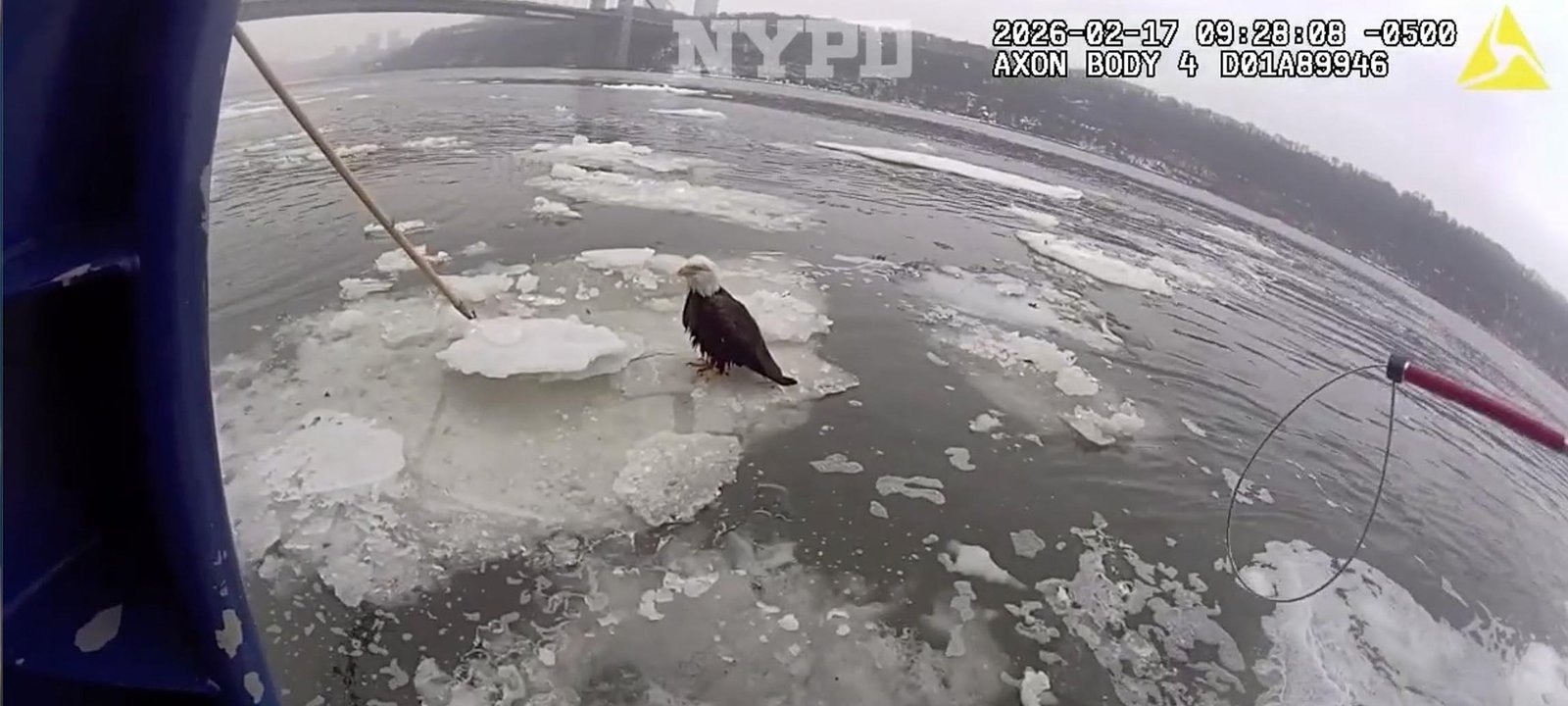
Imagem: Internet
Martin added that the rescue highlighted both the unpredictability of harbor patrol work and the importance of situational flexibility. “Our primary mission involves public safety and maritime security,” he said, “yet the same skill set often applies when wildlife is in distress. Reaction time and proper coordination can make the difference.”
No officers were injured during the operation, and departmental officials stated that all equipment used in the rescue was decontaminated afterward to prevent potential spread of avian pathogens.
Next Steps for the Eagle
The Raptor Trust will continue medical care for the bird, including assessments for bone fractures, internal injuries and possible exposure-related complications. If the eagle recovers fully, rehabilitation staff will initiate flight conditioning in an outdoor enclosure before considering release at a suitable habitat within its historical range.
Under federal law, recovered bald eagles must be released into the wild whenever feasible; permanent captivity is reserved only for birds that cannot survive independently. The average rehabilitation timeline for a raptor with moderate injuries ranges from several weeks to several months, depending on the severity of trauma and the bird’s response to treatment.
DEC officials indicated that they will monitor the bird’s progress through regular updates from the rehabilitation center. Should the eagle’s condition warrant, the state will coordinate with federal agencies to identify an appropriate release site, taking into account factors such as food availability, territorial behavior and migration patterns.
Increased Wildlife Encounters on Urban Waterways
The Hudson River corridor has seen a gradual rise in bald eagle sightings over the past two decades, partly due to successful conservation measures that banned certain pesticides and improved water quality. Winter brings additional raptors south from colder regions in search of open water and accessible fish, leading to occasional conflicts with ice and human infrastructure.
Harbor Unit commanders said Tuesday’s incident underscores the need for continued training that addresses not only maritime emergencies involving people but also unplanned interactions with protected wildlife. Discussions are underway to integrate brief modules on avian handling and to maintain specialized equipment on board during peak migration seasons.
For now, the officers involved hope the rescued eagle will eventually return to the skies over the Hudson. While they await word from rehabilitation specialists, the Harbor Unit resumes its routine patrols, mindful that the next unexpected call—human or animal—could come at any moment.
Crédito da imagem: NYPD


