Petraeus Sees Productive Pressure
Speaking with CNBC in Abu Dhabi on Thursday, Petraeus said the strategy’s critical tone could serve as a needed wake-up call. “Some of the Europeans needed to be gotten after,” he commented, noting that he had watched four successive U.S. presidents encourage Europe to invest more heavily in defense. According to Petraeus, former President Donald Trump proved “very, very substantial” in securing firmer spending commitments from allied governments.
Petraeus highlighted a pledge made earlier this year by European members of NATO to raise defense expenditures to 5 percent of gross domestic product, a target set after prolonged pressure from the Trump administration. The former commander of U.S. forces in Iraq said those commitments, if fulfilled, would mark significant progress toward a more balanced trans-Atlantic security partnership.
For context, the North Atlantic Treaty Organization has long urged members to devote a minimum of 2 percent of GDP to defense, a benchmark detailed on the alliance’s official website. The new 5 percent goal referenced by Petraeus would represent a substantial increase beyond that longstanding guideline.
Ukraine War Continues to Dominate Agenda
Petraeus’s remarks came amid ongoing diplomatic efforts to end Russia’s invasion of Ukraine. U.S. officials have reportedly held separate discussions with Russian and Ukrainian representatives in recent weeks in search of a framework for peace. Major sticking points include security guarantees for Kyiv, control of the Donbas region, and Russia’s insistence on a demilitarized Ukraine with no potential for NATO membership.
Washington is said to be encouraging the parties to reach an agreement before Christmas, though expectations for a breakthrough remain limited. Moscow has shown little willingness to scale back its objectives, which include territorial acquisition and the installation of a pro-Russian government in Kyiv. “Vladimir Putin is not going to budge,” Petraeus told CNBC, noting that the Russian leader continues to press maximalist demands.
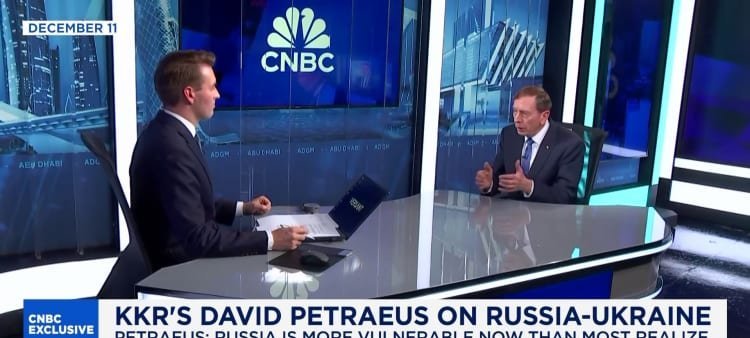
Imagem: Internet
Debate Over Frozen Russian Assets
Financing Ukraine’s defense and eventual reconstruction represents another critical challenge. European officials are assessing options to tap an estimated €210 billion in frozen Russian sovereign assets held within the bloc’s financial institutions. The European Union is reportedly nearing agreement on plans to channel a significant share of those funds toward Ukraine’s immediate war effort and long-term recovery, projected by the United Nations to exceed $500 billion.
Yet the proposal carries legal and geopolitical risks. Russia’s security council has warned that any move to appropriate its assets would be viewed as justification for escalation. Despite those concerns, Petraeus called the potential transfer a “game changer.” He argued that diverting even €100 billion to Kyiv could stabilize Ukraine’s fiscal position for several years, easing pressure on Western governments to provide continuous budgetary support.
Outlook for Trans-Atlantic Relations
The national security strategy’s frank appraisal of European shortcomings underscores a broader shift toward burden-sharing within the alliance. While criticism of the continent’s political resolve and military readiness rattled some European leaders, Petraeus maintains the approach could strengthen, rather than weaken, long-term cooperation by compelling allies to meet higher standards.
As negotiations over Ukraine’s future continue and debates over frozen Russian assets intensify, the effectiveness of the strategy’s pressure campaign will likely hinge on whether European governments follow through on their spending promises. For now, Petraeus concludes, the message from Washington is clear: sustained security in Europe will depend increasingly on European resources and resolve.
Crédito da imagem: Adam Jeffery | CNBC


