Yet the sector’s rapid ascent has also produced skeptics. JPMorgan Chase Chief Executive Jamie Dimon cautioned in October that credit problems rarely remain isolated, remarking, “When you see one cockroach, there are probably more.” In November, bond investor Jeffrey Gundlach described many private loans as “garbage” and predicted that the next significant financial shock could emerge from the asset class.
Market reaction and valuation challenges
Even without additional large bankruptcies, companies most closely tied to private credit—including Blue Owl Capital, Blackstone and KKR—continue to trade below recent peaks. Moody’s Analytics chief economist Mark Zandi stresses that while fast growth does not guarantee trouble, the combination of light regulation and limited transparency is a necessary condition for systemic risk.
One persistent concern involves how private lenders value the loans they originate. Because asset managers both extend and appraise these loans, they can delay recognizing borrower distress. Duke University law professor Elisabeth de Fontenay warns that investors and regulators lack clear visibility into whether reported valuations are accurate. She notes that debt tied to home-improvement firm Renovo was listed at face value shortly before being written down to zero during its November collapse.
Signs of strain among borrowers
Research from Kroll Bond Rating Agency anticipates a rise in defaults on private loans this year, particularly among lower-rated borrowers. Separately, data compiled by valuation firm Lincoln International and Bloomberg indicate that more borrowers are exercising payment-in-kind options—an arrangement that lets companies settle interest with additional debt rather than cash—to avoid default.
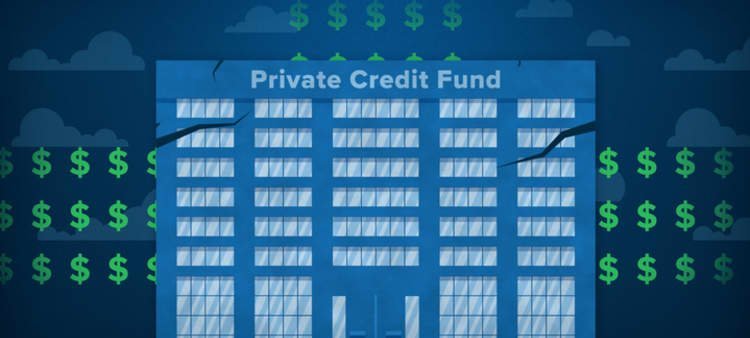
Imagem: Internet
Banks’ growing exposure
Although private credit competes with traditional banking, a portion of its recent growth has been funded by banks themselves. Disclosures following the autumn auto-industry bankruptcies revealed that Jefferies, JPMorgan and Fifth Third suffered losses tied to loans made to non-bank lenders. According to the Federal Reserve Bank of St. Louis, U.S. bank loans to non-depository financial institutions reached $1.14 trillion in 2023.
JPMorgan’s fourth-quarter presentation, released 13 January, showed that its lending to non-bank financial firms rose from about $50 billion in 2018 to roughly $160 billion in 2025. Zandi attributes some of this increase to deregulation enacted during the Trump administration, which freed capital for banks to resume riskier lending. He warns that intensified competition between banks and private credit managers could erode underwriting standards, potentially sowing “bigger credit problems down the road.”
Regulatory and systemic considerations
While neither Zandi nor de Fontenay foresees an imminent collapse, both emphasize that private credit’s continued expansion will amplify its significance to the broader financial system. Traditional banks operate under a well-defined regulatory framework designed to manage distress, but similar mechanisms are limited for non-bank lenders. De Fontenay questions whether regulators possess sufficient data to detect early warning signs within the private market, given its closed nature and sparse public disclosures.
For now, the absence of a cascade of failures has tempered concerns. Still, the mix of substantial growth, looser oversight and complex ties to the banking sector ensures that private credit will remain a focal point for investors and policymakers assessing the durability of the U.S. credit landscape.
Crédito da imagem: CNBC