Casualty Breakdown
Emergency services reported that 75 of the injured required hospital treatment. Of those, 15 remained in very serious condition, and five were described as critical on Monday morning. Medical teams set up triage stations alongside the track to stabilize victims before transferring them to hospitals in Córdoba, Seville and Madrid.
Passenger and Crew Details
Iryo, the private operator of the Málaga–Madrid service, confirmed that approximately 300 passengers and several crew members were on board when the derailment occurred. The state rail infrastructure manager ADIF said the Madrid–Huelva train carried an undisclosed number of travelers, most of whom were seated in the forward cars that absorbed the brunt of the impact.
Among the survivors was a woman identified by local media only as Ana, who was searching for her missing dog after being evacuated. Her sister remained hospitalized with serious injuries.
Operational Disruptions
All rail traffic between Madrid and the Andalusia region was suspended immediately after the crash. ADIF deployed engineers to inspect track integrity and overhead electrical systems, while investigators from the Civil Guard and the Commission for the Investigation of Railway Accidents (CIAF) secured the accident site.
The suspension affected thousands of passengers on Monday, prompting the national carrier Renfe to offer refunds and organize replacement bus services where possible. Authorities advised travelers to check schedules before heading to stations.
Condition of the Infrastructure
Minister Puente told reporters that the collision happened on a portion of track that underwent extensive renovation completed in May. He characterized the crash as “extremely unusual” for a modern high-speed corridor equipped with advanced signaling and automatic braking systems.
The line forms part of Spain’s Alta Velocidad Española (AVE) network, which meets technical standards defined by the European Union Agency for Railways. Spain’s high-speed system has generally maintained a strong safety record since operations began in the 1990s, making Sunday’s tragedy one of the deadliest rail events in the country’s recent history.
Investigative Efforts
Specialists from the CIAF, ADIF and Iryo began collecting data from onboard event recorders, reviewing track maintenance logs and interviewing crew members who survived. Weather conditions at the time were described as clear, and no immediate evidence pointed to sabotage or external interference.
Investigators will also assess whether the derailed train was traveling within the permitted speed limit and if automatic train protection systems activated correctly. Findings will be forwarded to the Ministry of Transport, Mobility and Urban Agenda, which is responsible for enforcing safety regulations.
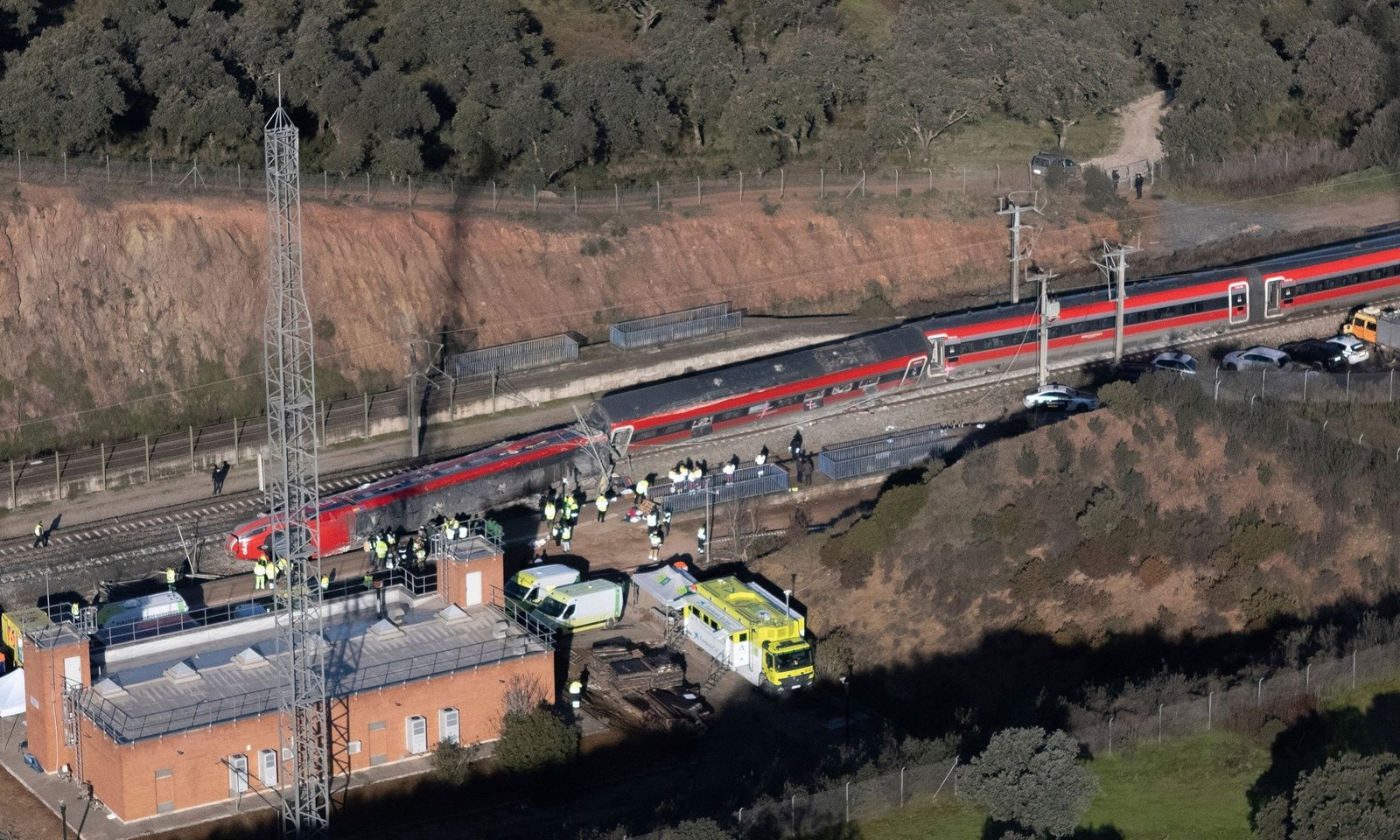
Imagem: Internet
Government Response
Prime Minister Pedro Sánchez expressed condolences to the victims’ families on social media and assured the public that the government would allocate all necessary resources to the investigation. Regional authorities in Andalusia declared three days of mourning, ordering flags flown at half-staff across public buildings.
In Madrid, the Ministry of Health activated its emergency protocol to distribute patients among regional hospitals, while the Red Cross set up a support center at Córdoba’s main station to help relatives locate missing passengers.
Statements from the Operator
Iryo issued a written statement saying it “deeply regrets” the incident and has “activated all emergency protocols, working closely with competent authorities.” The company added that it is providing accommodation and transport for stranded passengers and psychological assistance for those affected.
Industry analysts noted that the Málaga–Madrid route is among Iryo’s flagship services, operated with relatively new train sets introduced less than two years ago. The company had promoted the line for its competitive travel time and onboard amenities.
Historical Context
Spain’s most severe rail disaster in recent memory occurred in 2013, when a derailment near Santiago de Compostela killed 80 people. Since that event, major investments have been made to upgrade signaling systems and to improve driver training across the network. Sunday’s collision will likely prompt renewed scrutiny of rail safety practices and infrastructure maintenance.
Next Steps
Forensic teams are expected to continue working at the accident scene for several days. Once cleared, ADIF engineers will repair damaged track sections and overhead lines, aiming to restore partial service before the end of the week. Full service resumption will depend on the progress of both repair work and the official investigation.
Families of the deceased have been directed to a temporary assistance center in Córdoba, where police are conducting identification procedures. Psychological counselors and translators are on hand to aid relatives arriving from other regions or from abroad.
The Ministry of Transport has not provided a timeline for releasing preliminary findings, but officials said a report will be made public once technical assessments and witness interviews are complete.
Crédito da imagem: Guardia Civil / EPA / Shutterstock


