The Korean conglomerate has outlined a $5 billion infrastructure upgrade designed to lift Philadelphia’s output from roughly 1–1.5 ships per year to as many as 20. Two export-ready LNG carriers ordered by Hanwha Shipping are scheduled for delivery around 2028 through a joint-build process with Hanwha Ocean’s Geoje yard in South Korea, which turns out 50–60 vessels annually. The company has also placed orders for ten medium-range oil and chemical tankers, the largest U.S. commercial vessel contract in more than two decades; the first tanker is slated to launch in 2029.
Workforce limitations remain a critical obstacle. Hanwha Philly Shipyard Chief Executive David Kim said only 1,700 employees are currently on site, while 10,000 will be required to meet future production goals. To accelerate training, crews will rotate between Philadelphia and Geoje, allowing U.S. workers to learn from experienced Korean instructors. Expanded apprenticeship programs are also planned to bolster the talent pipeline.
Nuclear ambitions on the Delaware River
During Trump’s recent Asia tour, the president announced Hanwha would construct its first nuclear-powered submarine at the Philadelphia facility. Timelines depend on ongoing negotiations between the South Korean and U.S. governments, as well as technology transfers and resource allocation. The Navy is simultaneously modernizing its digital infrastructure; a new “ShipOS” platform developed with Palantir Technologies is intended to streamline design and maintenance for submarines and, eventually, aircraft carriers.
Italian and Midwestern link in the chain
Foreign participation extends beyond Korea. Italian-owned Fincantieri Marinette Marine (FMM) in Wisconsin remains part of the White House strategy despite recent turbulence. After the Navy canceled four frigate orders, FMM laid off 93 workers, reducing its build commitment from six vessels to two. Even so, the company employs nearly 3,000 people across three Wisconsin yards and coordinates with about 800 suppliers in 40 states, underlining shipbuilding’s broad industrial footprint.
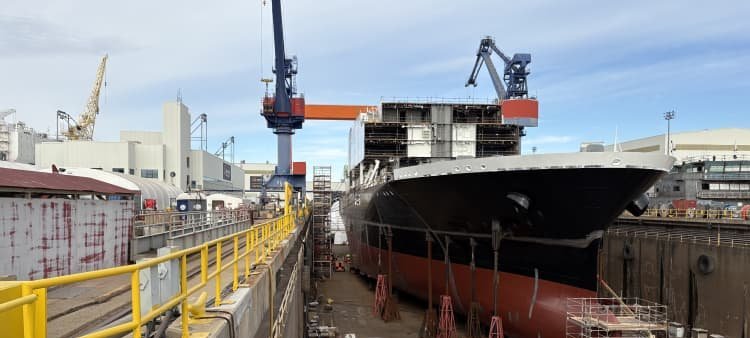
Imagem: Internet
Icebreakers and the Arctic frontier
U.S. capacity for polar icebreakers is also limited. The Coast Guard currently operates three ice-capable ships, including the 49-year-old heavy icebreaker Polar Star. By contrast, Russia fields 57 ice-class vessels and China five. To narrow the gap, Washington signed a $6.1 billion memorandum of understanding with Finland on 9 October. Under the agreement, Finnish yards Helsinki Shipyard and Rauma Marine Constructions will build four Arctic security cutters, while U.S. facilities construct seven more, with first delivery expected in 2028. A separate ICE Pact announced in November links the United States, Canada and Finland on Arctic defense collaboration.
Strategic context and trade backdrop
The administration’s shipbuilding push is intertwined with a Section 301 investigation by the Office of the U.S. Trade Representative, which concluded that Chinese subsidies and industrial policies unfairly restrict American commerce. The findings echo broader concerns highlighted by the Center for Strategic and International Studies over supply-chain vulnerabilities in critical defense sectors.
The Jones Act remains another structural factor. Only 55 Jones Act-compliant oil tankers exist, compared with roughly 7,500 worldwide, limiting the domestic fleet that can move cargo between U.S. ports. LNG participation is even smaller: just one U.S.-flagged LNG tanker operates today, and it was built in France. Analysts note, however, that America’s crude and LNG export volumes continue to grow despite reliance on foreign-built tonnage.
Whether the United States can ramp up from eight yards to a fleet pipeline capable of matching security requirements depends largely on how quickly overseas expertise—principally South Korean, Italian and Finnish—can be integrated into domestic facilities. For now, foreign capital, technology and labor training remain the linchpins of Trump’s goal to make American shipyards “great again.”
Crédito da imagem: Shawn Baldwin


