Immediate backlash from Democrats and advocates
Leading Democratic voices rejected the directive within hours of its release. Senator Amy Klobuchar of Minnesota characterized the order as likely illegal and said it undermines existing consumer protections. In Colorado, state Representative Brianna Titone, co-sponsor of a forthcoming anti-discrimination statute, stated that she intends to disregard the executive order, arguing that the president cannot unilaterally invalidate state policy.
Consumer group Public Citizen echoed that view. Co-president Robert Weissman described the order as largely symbolic and predicted that federal courts would block any attempt to nullify state regulations. Weissman encouraged state legislatures to continue drafting rules aimed at preventing algorithmic harm despite the White House initiative.
Industry voices seek congressional follow-through
Andreessen Horowitz head of government affairs Collin McCune welcomed the executive action as a first step toward national clarity but emphasized that only Congress can deliver a durable statutory framework. White House AI adviser Sriram Krishnan, a former partner at the same venture firm, told CNBC on Friday that the administration wants to collaborate with lawmakers on comprehensive legislation and intends to contest what it calls “doomer” laws that hinder U.S. competitiveness.
State measures in the spotlight
The order places particular attention on two Democratic-led states that recently adopted AI safeguards. In California, a law taking effect in January will require major AI developers to publish safety protocols. Colorado’s statute, scheduled for June, obliges companies to mitigate reasonably foreseeable risks of algorithmic discrimination. Supporters of both bills say the measures close critical gaps in consumer protection and will continue as planned unless a court explicitly rules otherwise.
Legal scholars note that executive orders cannot, by themselves, pre-empt state authority in areas where Congress has not legislated. Any attempt to suspend or invalidate state statutes is expected to trigger litigation over federalism and the separation of powers.
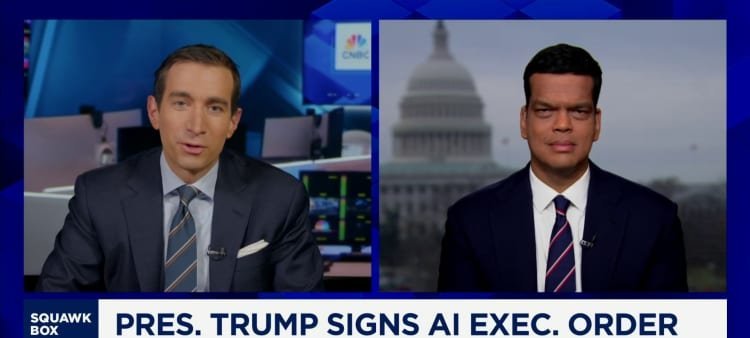
Imagem: Internet
Congressional context and earlier proposals
The controversy follows a recent but unsuccessful effort by some Republicans to insert a temporary moratorium on new state AI laws into the National Defense Authorization Act. That proposal was withdrawn amid bipartisan resistance, underscoring the complex balance between national uniformity and state autonomy.
Several lawmakers have advocated for a federal safety standard aligned with technical guidelines such as the National Institute of Standards and Technology’s AI Risk Management Framework. However, no comprehensive legislation has advanced to final passage, leaving the regulatory environment fragmented.
Chip sales add another layer to China strategy
Trump’s pledge to solidify U.S. dominance in AI comes as the administration authorizes Nvidia to sell its advanced H200 semiconductor chips to approved customers in China, provided the United States receives a 25 percent share of related revenues. Critics, including California state Senator Scott Wiener, contend that the chip decision undercuts the White House narrative of tough competition with Beijing.
Next steps
The task force led by the Justice Department has not yet released a timeline for identifying and contesting state laws. Until that process unfolds—likely alongside swift legal challenges—the immediate practical impact of the order remains uncertain. Observers expect courts to evaluate whether the administration can lawfully condition federal funding on a state’s willingness to amend its AI statutes and whether the executive branch possesses adequate authority to pre-empt state regulation absent congressional action.
Crédito da imagem: Al Drago | Reuters


