Aaron Roth, a retired U.S. Coast Guard captain now with the Chertoff Group, noted that curbing Venezuelan exports has a dual impact: it tightens economic pressure on President Nicolás Maduro while limiting access to discounted heavy crude that Chinese refiners prefer. Venezuela has produced about 900,000 barrels a day of crude and condensate in 2025, roughly 1 percent of global supply. Kpler estimates that China purchases 76 percent of that volume, while U.S. buyers account for about 17 percent — half the share imported in 2024. Cuba, Spain and Italy absorb most of the remainder.
How the Centuries was tracked
Kpler imagery and automatic identification system (AIS) data show the Centuries loaded two million barrels of Merey crude at Venezuela’s José Oil Terminal on 9 December. In the days before loading, the vessel broadcast spoofed AIS positions suggesting a course toward Curaçao, yet satellite images placed it off the Venezuelan coast as early as 4 December. After loading, the tanker lingered near Lechería on 16 December before moving south of Grenada on a path consistent with a voyage to Asia.
The market often remains unaware of a vessel’s final destination until long after departure because operators use false signals and at-sea transshipments to mask cargo origin. Both tankers seized last weekend have supplied China in the past: the Centuries delivered Venezuelan crude to Shandong’s Yantai terminal in April 2020, while the empty Bella 1 — also detained — carried Iranian oil to Qingdao in March and Venezuelan crude to Qingdao and Tianjin in May 2023.
Legal backdrop and geopolitical context
By boarding the Centuries under Panamanian flag, the United States used a legal mechanism that requires cooperation from Panama. Brandon Daniels, chief executive of supply-chain consultancy Exiger, said such operations typically need flag-state consent, which can be expedited under Salas-Becker or similar frameworks. Panama, one of the world’s largest flag registries, values its sovereignty but also relies on U.S. partnership to safeguard canal revenues and maritime services.
Tensions over the Panama Canal add another layer to the dispute. President Trump has accused China of wielding “influence and control” through Hong Kong-based CK Hutchison, operator of the Balboa and Cristóbal ports at each end of the waterway. A preliminary deal for those terminals between CK Hutchison and a consortium led by BlackRock’s Global Infrastructure Partners and Mediterranean Shipping stalled earlier this year, partly because Beijing has pushed for state-owned carrier Cosco to obtain a controlling stake.
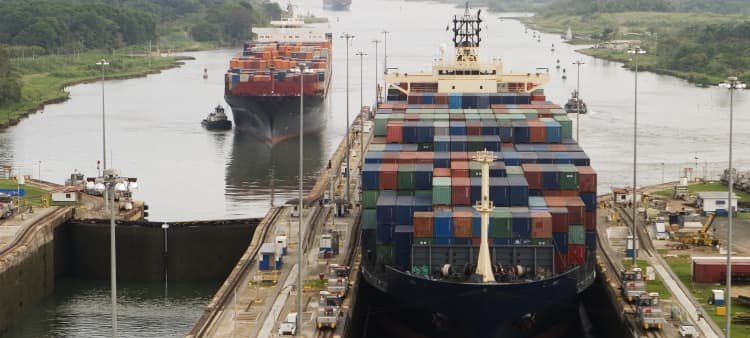
Imagem: Internet
Peter Sand, chief analyst at freight-rate platform Xeneta, said the tanker seizures demonstrate how geopolitics increasingly shapes maritime trade. Should Washington detain a vessel clearly bound for China, analysts expect a sharper response from Beijing, potentially complicating broader negotiations between the two powers.
The White House declined to comment on the weekend operations, and both the U.S. Coast Guard and the Department of Transportation referred inquiries to the administration.
Implications for global oil flows
Cutting off discounted Venezuelan crude forces Chinese refiners to seek heavier grades from Russia or the Middle East, potentially at higher prices and under different contractual terms. For the Maduro government, seizure of Panama-flagged ships threatens a key workaround used to get oil to market despite U.S. sanctions first imposed in 2019. Industry specialists see the risk extending to stateless tankers, a fleet Washington considers especially vulnerable because they lack diplomatic protection.
The Office of Foreign Assets Control maintains a detailed list of sanctioned entities and vessels, underscoring the breadth of restrictions facing shippers involved in Venezuelan trade. Additional information on U.S. sanctions programs is available from the Treasury Department’s public resources (Treasury Department – Venezuela Sanctions).
Market participants now watch the movements of the Ragnar, Balsa and Larko for clues about the next enforcement action. Any attempt by those vessels to clear Venezuelan waters could prompt further U.S. intervention, reinforcing the blockade strategy and increasing the likelihood of a direct confrontation with China over energy supply routes.
Crédito da imagem: Department of Homeland Security via Reuters


