The White House estimates the ballroom’s cost at $300 million, funded entirely through private donations. In October, officials said the fundraising total had already reached $350 million. The administration attributes the surplus to continuing contributions from supporters who want the ballroom added to the Executive Mansion. President Trump told reporters on Oct. 24 that the additional $50 million might finance a triumphal arch modeled on Paris’ Arc de Triomphe, though no formal design or location for the monument has been announced.
Public opinion data show widespread skepticism about removing the East Wing. A national poll conducted in October by The Washington Post and Ipsos found that 56 percent of U.S. adults oppose the demolition, including 45 percent who said they “strongly” oppose it. Twenty-eight percent expressed support, with 15 percent strongly in favor, while 16 percent were undecided. Opposition was recorded across most demographic groups, though the survey indicated higher approval among respondents who identified as strong supporters of the president.
The ballroom is planned to host state dinners, official ceremonies and large-scale press events that currently strain the capacity of existing facilities in the White House complex. The project’s backers argue that a purpose-built hall will enhance security and operational efficiency by reducing the need to erect temporary structures for marquee gatherings.
Demolition work began in late September, proceeded without interruption through the government shutdown and is scheduled to transition to vertical construction early next year. Contractors are operating under a compressed timeline that aims to complete the exterior by the end of 2027, with interior finishes following in 2028. Building permits were issued by the National Capital Planning Commission, which granted conditional approval after reviewing security, historical preservation and environmental impact assessments.
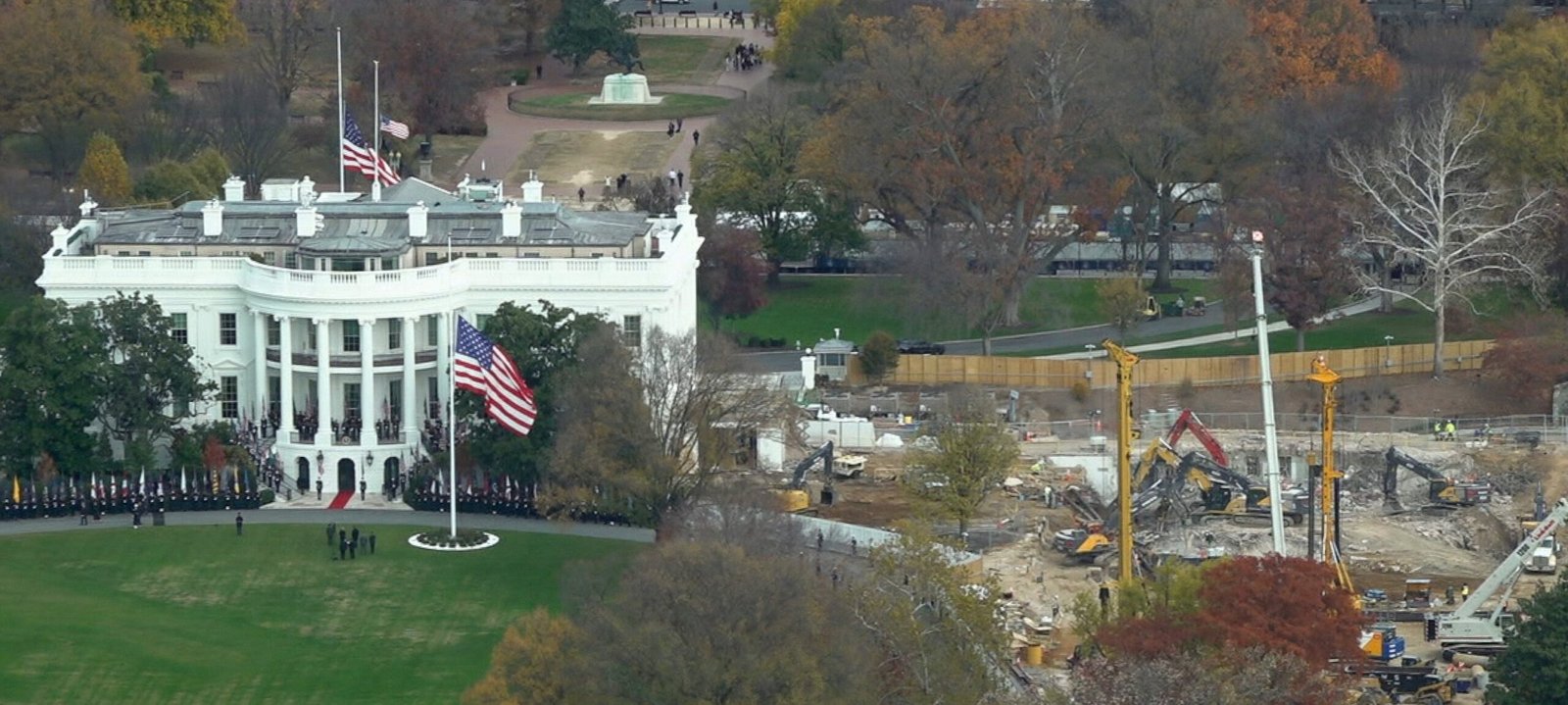
Imagem: Internet
Preservationists have raised concerns about the loss of historic fabric. The East Wing’s original 1902 footprint was designed by architect Charles McKim as part of an expansion that added the West Wing. While the East Wing underwent significant alterations during World War II, its exterior appearance remained largely consistent for more than eight decades. The White House has pledged to archive salvageable architectural elements and display selected artifacts in a museum space planned within the new ballroom’s lobby.
For context on the East Wing’s architectural history, the National Park Service notes that the wing originally served as a guest entrance and military office space before evolving into the center of first-lady operations.
Project managers say private funding will insulate taxpayers from direct costs, though critics counter that ongoing maintenance and security expenses will ultimately be borne by federal budgets. The White House has not released detailed financial projections for long-term operational outlays.
As visible construction advances, tourists gathering on the Washington Monument’s observation deck now look down on an open expanse of earth where the East Wing once stood—an early visual marker of one of the most extensive alterations to the Executive Mansion in decades.
Crédito da imagem: Library of Congress


