
A wave of multibillion-dollar data center projects is reshaping local economies across the United States, but the permanent payrolls tied to these facilities remain small when measured against the capital required to build them.
In Lebanon, Indiana, a new campus announced by Meta in February carries a price tag of roughly $10 billion. Construction is expected to peak at more than 4,000 workers, yet the operator projects that only about 300 full-time positions will remain once the site is fully online. The figures translate to one permanent job for every $33 million invested.
Employment density is somewhat higher in the semiconductor industry, yet still far below that of traditional manufacturing. Taiwan Semiconductor Manufacturing Company (TSMC) plans to spend $165 billion to complete an array of fabrication plants in Phoenix, Arizona, and other U.S. locations. Company leadership has indicated that, when all facilities are operational, approximately 12,000 direct positions will be created—equal to one job per $14 million of capital expenditure.
Independent research underscores the gap between data centers and broader economic activity. A January 2026 review of Virginia’s incentive programs, based on three decades of state data, found that hyperscale data centers in the Commonwealth average one permanent position for every $13 million invested. Outside the data-center sector, the study placed the cost of generating an additional job at roughly $137,000, or about 100 times less capital per worker.
The labor-to-capital imbalance is drawing increased scrutiny from county boards, state legislatures and economic development agencies. Officials who court data center operators frequently cite the short-term influx of construction work, but stakeholders are beginning to question the long-term return on taxpayer subsidies once the ribbon is cut and the permanent staff is in place.
Automation plays a central role. Forecasts published in November 2025 by the Hamm Institute show that large-scale facilities rated at 100 megawatts or more can operate with as few as 20 to 30 employees per 100 MW. Industry benchmarks compiled in May 2026 place the typical range at 25 to 40 operators for the same capacity band. In practice, a hyperscale campus housing several hundred megawatts of servers can function with a workforce that barely reaches triple digits.
Recent project announcements illustrate the trend. Amazon Web Services intends to spend $35 billion through 2040 to develop multiple campuses in Virginia, a plan the governor’s office estimates will result in at least 1,000 new jobs statewide. Spread over 17 years, the program equates to one position for every $35 million in capital and less than 60 jobs per year on average.
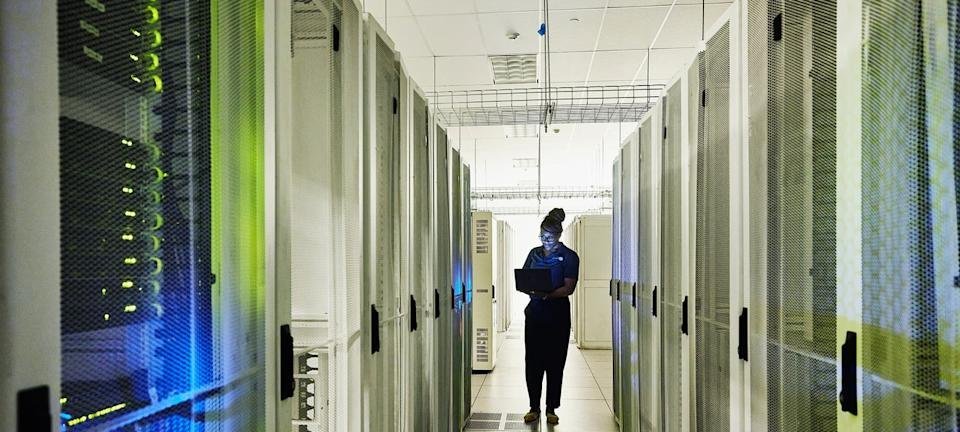
Imagem: Internet
Smaller projects show similar ratios. Ark Data Centers is expanding its Ohio footprint with a $136 million build-out slated to deliver just 10 permanent roles, public records indicate. For conventional retail data centers consuming two to five megawatts, employment typically hovers around 30 staff members. Even the largest hyperscale campuses, which can exceed one gigawatt of capacity, rarely top 1,000 permanent employees.
The modest headcounts stand in contrast to broader U.S. labor metrics. According to the U.S. Bureau of Labor Statistics, the average capital requirement across all industries to create a new position is measured in the low hundreds of thousands of dollars, not tens of millions. Analysts note that data centers deliver other economic benefits—chiefly, property-tax revenue and demand for local energy infrastructure—but acknowledge that sustained employment growth is not among the sector’s primary contributions.
Despite the limited job totals, states continue to compete aggressively for hyperscale investments, offering tax abatements, discounted land and accelerated permitting. Proponents argue that the facilities anchor broader technology ecosystems, attract suppliers and elevate a region’s profile in an increasingly data-driven global economy. Critics counter that the emphasis on capital investment figures can obscure the limited long-term payroll advantages, particularly in rural or suburban areas where economic diversification is a stated policy goal.
For communities weighing the trade-offs, the arithmetic is straightforward: billions of dollars can secure hundreds of construction jobs and, ultimately, dozens—or at most a few hundred—ongoing positions. As demand for artificial-intelligence computing power accelerates, industry observers expect the construction boom to continue. Whether local residents see those billions translated into substantial, lasting employment remains a central question for policymakers nationwide.