
The Bank of England’s Monetary Policy Committee (MPC) meets on Thursday for its final interest-rate vote before the government announces the Autumn Budget on 26 November. Most economists expect the nine-member panel to leave the Bank Rate unchanged at 4 percent, yet several analysts caution that a reduction cannot be ruled out.
Forecasts compiled ahead of the meeting show a broad consensus for a pause, reflecting concerns among policy makers about lowering borrowing costs too swiftly while inflation remains above the Bank’s 2 percent target. Oxford Economics noted that many MPC members are more worried about cutting rates “too quickly rather than too slowly,” and will want firmer evidence of sustained disinflation and moderating wage growth before moving.
Even so, a minority of institutions—among them Barclays, Nomura, Mizuho and Unicredit—believe the committee could surprise markets with an immediate 25-basis-point cut to 3.75 percent. Julien Lafargue, chief market strategist at Barclays Private Bank, described the choice as “finely balanced,” pointing to a backdrop of lacklustre growth, cooling price pressures and softening labour indicators.
The stakes are high because Thursday’s decision will set the tone for monetary policy heading into the fiscal statement later this month. Chancellor Rachel Reeves is widely expected to unveil tax increases aimed at closing a projected £20 billion to £50 billion fiscal gap. The shortfall reflects lower productivity assumptions, higher debt-servicing costs and recent reversals of planned welfare savings. Any fiscal tightening, particularly through higher income tax, could curb household demand and place additional downward pressure on inflation.
Inflation and labour market trends
Headline consumer price inflation stood at 3.8 percent in September, unchanged for a third consecutive month. While the figure is well below last year’s double-digit peaks, it remains nearly double the central bank’s target. Core services inflation and private-sector pay growth continue to run above target-consistent levels, but recent readings have shown tentative signs of deceleration.
Labour market data have also moderated. Analysts at JPMorgan say an increase in the unemployment rate to 4.9 percent in September would be an important signal that slack is emerging in the jobs market. Further “soft sequential gains” in core services CPI and wage settlements could strengthen the case for rate cuts at upcoming meetings, according to JPMorgan chief U.K. economist Allan Monks.
Timing of potential easing
UBS Global Wealth Management economist Dean Turner described the November meeting as “one of the hardest to call for some time.” Turner expects the MPC to leave policy unchanged this week but to indicate that a reduction could occur as soon as December, and no later than February. Although the committee will not publish new forecasts in December, members will have the benefit of fresh budget details and an updated assessment of their impact on growth and inflation.
Market pricing aligns with that view. Interest-rate futures imply a high probability of a 25-basis-point cut at either the 19 December or 6 February meetings, followed by at least one additional reduction later in 2026. Berenberg economist Andrew Wishart argues that front-loaded fiscal tightening, such as an income-tax rise, would bolster the case for two cuts next year, taking Bank Rate to 3.50 percent, and potentially a third in 2026 to 3.25 percent.
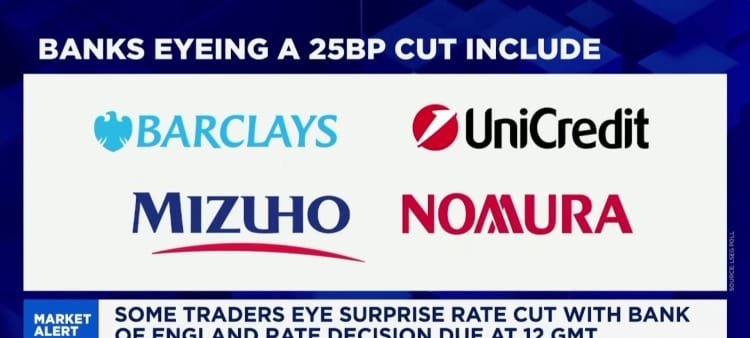
Imagem: Internet
For the moment, central bankers remain cautious. Deputy Governor Ben Broadbent recently emphasised that policy “cannot be set on automatic pilot,” underscoring the MPC’s data-driven approach. Members have repeatedly stated they need to see clear evidence that price and wage pressures are easing sustainably before shifting to an outright easing cycle.
Market and policy implications
A decision to keep rates steady would likely support the pound and maintain current gilt yields, at least in the short term. Conversely, an unexpected cut could trigger a rally in government bonds and weigh on sterling as investors price in a faster pace of easing. Traders will scrutinise the vote split for clues on how close the committee is to its first reduction since rates peaked earlier this year.
Beyond Thursday’s announcement, attention will swiftly turn to fiscal policy. Reeves is scheduled to deliver the Autumn Budget in the House of Commons on 26 November, outlining revenue and spending plans for the coming years. Should the chancellor implement sizeable tax increases, the combined effect of tighter fiscal conditions and cooling inflation could accelerate the pivot toward lower interest rates.
The Bank of England provides an overview of its policy framework, including the role of Bank Rate, on its official website. Interested readers can review the central bank’s mandate and recent decisions here.
The MPC’s statement, vote breakdown and minutes will be released at 12:00 GMT on Thursday, after which Governor Andrew Bailey will hold a press conference to elaborate on the committee’s assessment of economic conditions.
Crédito da imagem: AFP via Getty Images