
The U.S. airline industry began a new round of disruption on Friday after the Federal Aviation Administration instructed carriers to scale back operations because of staffing shortages among air traffic controllers who have not been paid during the protracted federal government shutdown. By 2 p.m. ET, aviation data provider Cirium recorded approximately 780 canceled domestic flights, representing about 3 percent of the day’s planned schedule.
Escalating Cutback Schedule
Under the FAA directive, flight reductions will widen over the coming week. The agency outlined a phased plan that starts with a 4 percent cut on Friday, rises to 6 percent on Tuesday, reaches 8 percent by Thursday and peaks at 10 percent on November 14. The directive applies to dozens of major facilities, including hubs such as Atlanta Hartsfield-Jackson, Chicago O’Hare, Los Angeles International and New York’s trio of JFK, LaGuardia and Newark Liberty airports.
Friday’s cancellation tally ranks as the 72nd largest single-day disruption for U.S. carriers since January 1, 2024, a period that also includes last winter’s Southwest operational collapse and widespread delays at Delta following a technology outage.
Operational Impact on Airlines
Network carriers said the order is primarily affecting regional operations that shuttle passengers to smaller markets. United Airlines reported no cancellations on its hub-to-hub or long-haul international routes. American Airlines removed 221 flights from its schedule, avoiding one-flight-per-day destinations and instead trimming frequencies in high-traffic corridors. Examples include cutting Dallas/Fort Worth–Northwest Arkansas departures from 10 to eight and Boston-Logan–Ronald Reagan Washington National service from 10 to nine.
American Airlines Chief Executive Robert Isom described the directive as “frustrating” and warned that the scale of flight cuts is expected to grow. Across the industry, carriers have been repositioning aircraft and crews with little notice to maintain coverage on still-operating routes.
Financial and Consumer Repercussions
The immediate revenue impact remains difficult to quantify. Some analysts note that fewer available seats can lift unit revenue if demand holds steady, but a prolonged shutdown could dampen booking activity. Wolfe Research told clients that the net effect on near-term demand may be negative despite potential fare increases.
With commercial seats at a premium, alternative travel options are drawing interest. Hertz said one-way car rentals booked during the past 48 hours rose more than 20 percent compared with the same period a year earlier, indicating that some passengers are opting to drive rather than contend with uncertain flight schedules.
Guidance for Passengers
Airlines are offering rebooking options and waiving change fees for affected customers. Travel advisers recommend using carrier mobile apps and websites to monitor real-time changes and to verify the specifics of any travel insurance coverage. Policies often depend on how an airline categorizes the cause of a delay or cancellation, meaning compensation is not guaranteed.
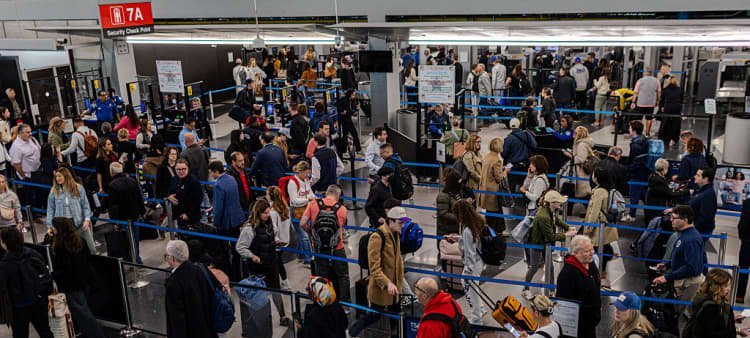
Imagem: Internet
AAA advises arriving at the airport at least two hours before departure, avoiding checked baggage when possible and maintaining flexibility in itineraries. Squaremouth, a travel-insurance comparison platform, cautions that shutdown-related claims can be denied if the carrier lists a generic reason for cancellation.
Airports Under the FAA Order
The FAA and the Department of Transportation identified the following airports as subject to schedule reductions: Anchorage (ANC), Atlanta (ATL), Baltimore/Washington (BWI), Boston (BOS), Charlotte (CLT), Chicago Midway (MDW), Chicago O’Hare (ORD), Cincinnati/Northern Kentucky (CVG), Dallas Love (DAL), Dallas/Fort Worth (DFW), Denver (DEN), Detroit (DTW), Fort Lauderdale (FLL), Honolulu (HNL), Houston Hobby (HOU), Houston Intercontinental (IAH), Indianapolis (IND), Las Vegas (LAS), Los Angeles (LAX), Memphis (MEM), Miami (MIA), Minneapolis/St. Paul (MSP), New York JFK (JFK), New York LaGuardia (LGA), Newark Liberty (EWR), Oakland (OAK), Ontario (ONT), Orlando (MCO), Philadelphia (PHL), Phoenix (PHX), Portland (PDX), Ronald Reagan Washington National (DCA), Salt Lake City (SLC), San Diego (SAN), San Francisco (SFO), Seattle/Tacoma (SEA), Tampa (TPA), Teterboro (TEB) and Louisville (SDF).
Additional details about the directive are available on the Federal Aviation Administration’s official website.
Although the cuts coincide with a traditionally slower travel period that precedes the Thanksgiving surge, the lack of certainty is prompting many travelers to reassess plans. Industry executives say maintaining reliable service will become increasingly challenging if the shutdown persists and staffing shortages deepen.
Crédito da imagem: Afp