
A federal court on Friday permanently prohibited former President Donald Trump from deploying federalized National Guard troops in Portland, concluding that the White House overstepped its legal authority when it ordered the mission in late September 2025.
U.S. District Judge Karin Immergut, who was appointed to the bench by Trump, issued a 106-page decision following a three-day bench trial in Portland. The ruling converts a temporary restraining order she released last month into a lasting injunction that bars the federal government from activating Oregon National Guard personnel for crowd-control or security operations related to the city’s Immigration and Customs Enforcement facility.
“The evidence demonstrates that these deployments, which were objected to by Oregon’s governor and not requested by the federal officials in charge of protection of the ICE building, exceeded the president’s authority,” Immergut wrote. Her order states that immigration-related demonstrations, some of which had been underway for months, did not rise to the level of “rebellion” or “imminent danger of rebellion” required under federal law for a president to assume command of a state’s National Guard.
Trump’s directive, issued on Sept. 29, 2025, federalized approximately 200 members of the Oregon National Guard. The administration argued the move was necessary to safeguard federal property after extended nightly protests outside the South Portland ICE facility. State officials, including Oregon Gov. Kate Brown, and Portland Mayor Ted Wheeler opposed the action, asserting that local and state law enforcement had the situation under control.
The city of Portland and the state of Oregon filed suit immediately after the federalization order, contending that the president had misapplied statutory authority traditionally invoked under the Insurrection Act of 1807, which allows domestic military deployments only under tightly limited circumstances. During trial, Justice Department attorneys maintained that sustained vandalism, arson attempts and clashes with federal agents demonstrated an environment akin to insurrection. Immergut disagreed, concluding that the record showed “no evidence of organized, armed resistance or any threat that local authorities were incapable of managing.”
The judge’s order also referenced a separate attempt by Trump to federalize National Guard units in Illinois for potential deployment in Chicago earlier in 2025. That effort was similarly rejected by local officials and later halted by the U.S. Court of Appeals for the Seventh Circuit, which found “scant evidence of rebellion.” Immergut wrote that both cases illustrate the uncertainty surrounding the threshold for invoking federal military power in civilian contexts, adding that “the precise standard is ultimately a question for a higher court to decide.”
Under federal law, National Guard forces remain under state control unless a president formally activates them under Title 10 of the U.S. Code. Once federalized, troops become part of the active-duty military chain of command. Immergut ruled that the president’s September proclamation failed to meet statutory prerequisites, noting that Oregon officials had not requested assistance and that Department of Homeland Security leaders responsible for the ICE facility testified they did not seek Guard support.
Friday’s decision permanently enjoins the federal government from deploying Oregon Guard personnel to Portland for protest-related duties without either state consent or a judicial finding that conditions satisfy the legal definition of rebellion. The ruling does not restrict the federal government’s ability to use its own law enforcement agencies to protect federal property.
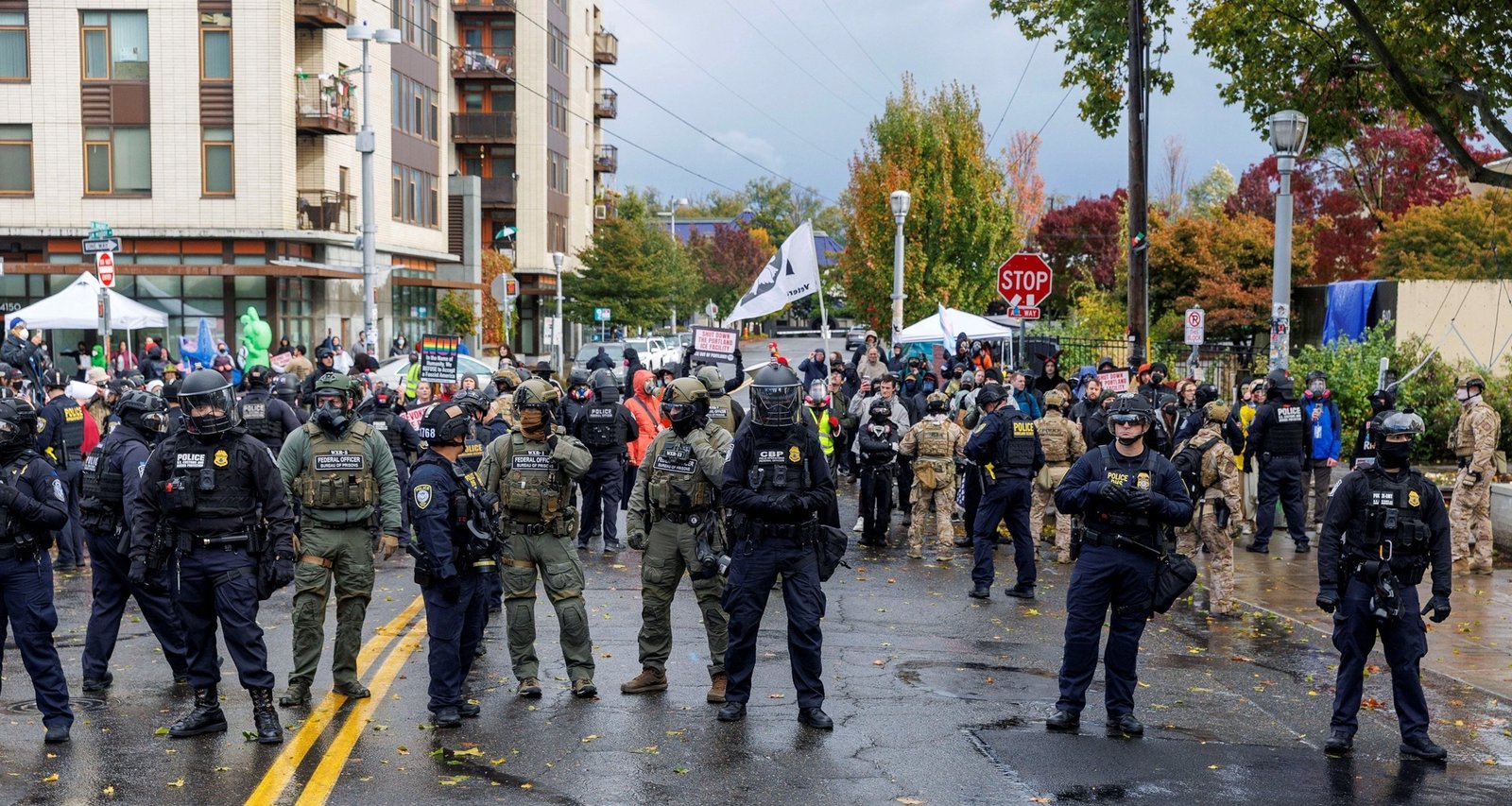
Imagem: Internet
White House attorneys did not immediately say whether they will appeal, but Immergut acknowledged that the stakes “are national in scope,” given Trump’s public statements threatening to dispatch Guard troops to several Democratic-led cities. An appeal would send the matter to the U.S. Court of Appeals for the Ninth Circuit and could ultimately reach the Supreme Court.
The protests outside Portland’s ICE building began in mid-2025, echoing earlier demonstrations over federal immigration enforcement. Participants accused Immigration and Customs Enforcement of mistreatment of detainees and called for the facility’s closure. Nightly gatherings occasionally involved property damage and confrontations with federal security personnel, but local authorities reported no deaths or shootings connected to the demonstrations.
In testimony, Oregon National Guard commanders said they received less than 48 hours’ notice of the federalization order and had not planned for domestic security operations in Portland. State officials argued that sudden activation disrupted wildfire response preparations elsewhere in Oregon. Immergut cited that evidence in concluding the deployment did not align with any documented emergency beyond routine protest activity.
Legal observers note that the ruling could influence future administrations. By articulating the limits of executive power under the Insurrection Act—last invoked during the 1992 Los Angeles riots—the court added precedent emphasizing state primacy in National Guard control absent clear insurrection.
For Portland, the injunction removes the prospect of military involvement unless state leaders request it. City officials said they will continue coordinating protest management through local police, Oregon State Police and federal protective services assigned to the ICE facility.
Crédito da imagem: John Rudoff/Reuters