
Microsoft Chief Executive Officer Satya Nadella signaled plans to add employees while emphasizing that any future hiring will be heavily influenced by productivity gains from artificial intelligence. Speaking with investor Brad Gerstner on the “BG2” podcast released Friday, Nadella said the company aims to grow its workforce “with a lot more leverage” compared with the pre-AI era.
Microsoft ended its 2025 fiscal year in June with 228,000 employees, the same total reported 12 months earlier. The flat headcount followed several layoff rounds that eliminated at least 6,000 positions during the fiscal year. Another 9,000 jobs were cut in July, narrowing the overall number before the new fiscal period began.
Nadella acknowledged the recent reductions but argued that artificial intelligence is reshaping how employees work and how many people are required for specific tasks. “The headcount we grow will grow with a lot more leverage than the headcount we had pre-AI,” he told Gerstner. He added that staff members are in an “unlearning and learning” phase that he expects to last about a year, after which hiring will resume with greater efficiency in mind.
The comments come as Microsoft intensifies efforts to embed generative AI across its product portfolio. The company already offers AI capabilities in Microsoft 365 applications and in GitHub Copilot, a coding assistant that relies on large language models from OpenAI and Anthropic. OpenAI’s ChatGPT assistant, introduced in 2022, accelerated industrywide interest in generative AI and spurred Microsoft to deepen its partnership with the San Francisco–based research company.
Microsoft’s workforce has fluctuated in recent years. Headcount expanded 22% in fiscal 2022, well before the latest wave of AI adoption, and then contracted through fiscal 2025 as demand patterns shifted and the company moved to streamline operations. Nadella framed the next phase as one in which smaller, more specialized teams will rely on AI agents to accomplish tasks that previously required larger groups.
He cited an internal example involving a manager responsible for networking fiber. Faced with surging data-center requirements linked to cloud services, the executive determined that conventional hiring could not keep pace. Instead, her team built AI agents to oversee maintenance, allowing existing staff to cover broader workloads without proportional increases in personnel.
Nadella compared today’s transition to earlier shifts in office technology. In the past, interoffice memos and forecasts were distributed by fax before email and Excel spreadsheets transformed collaboration. “Right now, any planning, any execution, starts with AI,” he said, describing a workflow in which research, ideation and document sharing are increasingly filtered through intelligent assistants.
Microsoft’s stance contrasts with simultaneous workforce reductions at other large technology firms. Amazon this week eliminated 14,000 corporate positions as part of a cost-cutting drive. In an internal memo, Senior Vice President Beth Galetti described the current generation of AI as the most transformative technology since the internet, noting that it allows companies to innovate faster in both existing and new market segments. Amazon and Microsoft compete to provide cloud infrastructure for organizations that train and deploy advanced AI models.
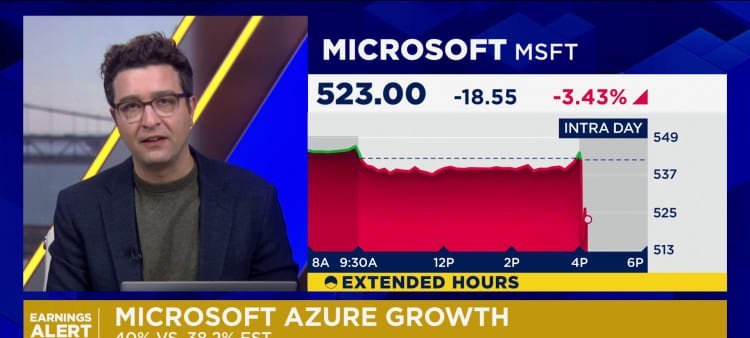
Imagem: Internet
Financial results released Wednesday highlighted Microsoft’s momentum in that arena. The company reported year-over-year revenue growth of 12% and posted its widest operating margin since 2002. Demand for Azure, the cloud platform underpinning many of Microsoft’s AI services, was a key contributor to those figures.
Looking ahead, Nadella stressed that making AI tools available to every employee remains a priority. He said giving workers access to Copilot features in Microsoft 365 and to AI-powered coding assistance on GitHub should help teams reorient their daily routines more quickly. The objective is to ensure that future headcount increases coincide with measurable productivity gains rather than merely adding personnel to meet rising workloads.
While Nadella did not provide specific hiring targets or timelines, his remarks suggest that Microsoft’s next growth cycle will depend less on sheer numbers and more on the strategic deployment of AI to amplify individual output. The approach mirrors broader trends in the technology sector, where companies are balancing investment in generative models with efforts to manage costs and refine operational structures.
For now, Microsoft executives appear focused on completing the internal transition they view as necessary for AI-driven work. Once the organization finishes what Nadella called a year of “learning and unlearning,” the company expects to resume adding employees—though likely at a different ratio of staff to revenue than in previous cycles.
Crédito da imagem: David Ryder / Bloomberg