
The scramble to control the U.S. House of Representatives in next year’s midterm elections is being redrawn—literally. A wave of mid-decade redistricting in several states has forced both major parties to reassess which seats are truly competitive and where resources should be deployed.
Republican-Driven Maps Alter the Landscape
Four states—Texas, Missouri, North Carolina and Ohio—have completed new congressional boundaries outside the normal post-census cycle. Texas, acting at the urging of former President Donald Trump, approved its map in August 2025. The plan clusters large numbers of Democratic voters in urban and suburban districts while expanding the geographic reach of Republican-held seats into areas that favored Trump in 2024.
Missouri and North Carolina each converted one previously competitive district into territory more favorable to Republicans. Ohio, required by state law to redraw after its first map was rejected, adopted what officials there described as a compromise. Even so, analysts say the new Ohio lines tilt two additional districts toward the GOP.
Combined, the four states could give Republicans as many as nine extra seats: five from Texas, two from Ohio, and one each from Missouri and North Carolina.
Democrats Look to California for Balance
Democratic strategists hope to blunt those gains with Proposition 50 in California. The ballot measure, decided Tuesday, would revise five districts to lean more Democratic. Supporters argue the change would counter the partisan edge created in Texas.
California is the nation’s largest congressional delegation, and even a small shift there can influence the overall House math. If the measure passes, Democrats estimate they could reclaim several seats lost in 2024 and protect incumbents in areas that have trended marginally Republican.
Additional States Under Review
Activity is not limited to the six states mentioned above. Utah lawmakers approved a fresh map after a court invalidated the previous plan; that proposal now awaits further legal review. Indiana’s Republican-controlled legislature will convene a special session to consider new boundaries, while the Democratic-led legislature in Virginia has taken initial steps toward its own redraw.
Elsewhere, officials in Florida, Nebraska, Louisiana, Kansas, Maryland and Illinois have publicly discussed possible mid-decade map revisions but have not finalized timetables. Any of those changes could again alter partisan calculations.
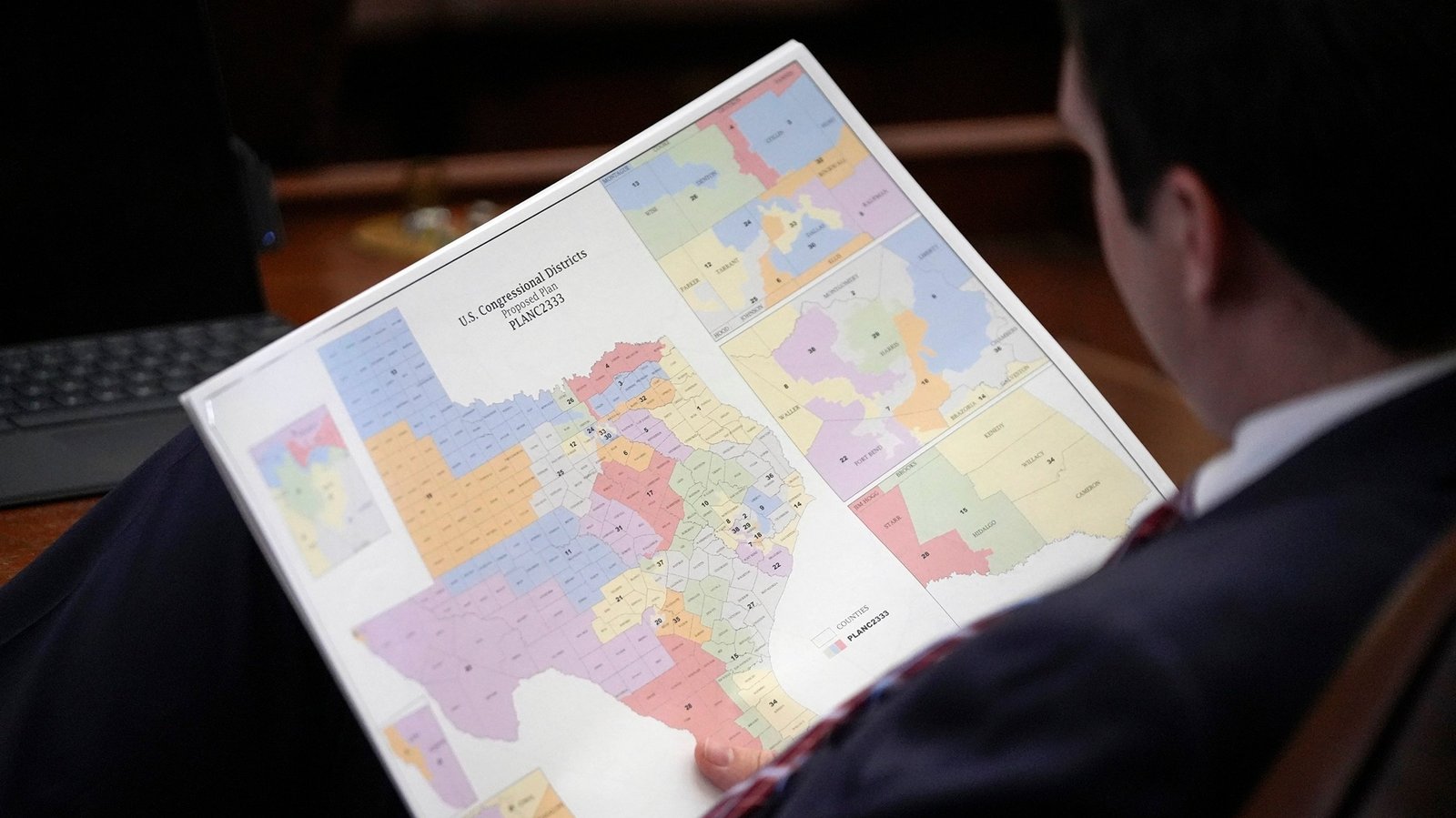
Imagem: Internet
Narrow House Margin Raises the Stakes
The House currently stands at 219 Republicans and 213 Democrats, with three vacancies. Once those seats are filled, Democrats would need a net gain of three to recapture the majority. Although campaigns had already identified dozens of targets based on 2024 voting patterns, the new maps remove some swing districts from contention while creating fresh opportunities elsewhere.
For example, 13 Democrats won House races in 2024 in districts carried by Trump, according to the University of Virginia’s Center for Politics. Four of those seats—Texas’s 28th and 34th, North Carolina’s 1st and Ohio’s 9th—are now significantly more Republican. Conversely, only three Republicans hold seats in districts won by President Kamala Harris, limiting Democratic pickup potential on the existing map.
Republican campaign strategists believe Texas offers the clearest path to additional gains and have added three newly drawn Democratic-held seats there to their official target list. Democratic organizers counter that early fundraising and voter engagement trends remain favorable and that close coordination with incumbents in the redrawn seats could preserve their positions.
Supreme Court Could Intervene Again
Further uncertainty looms at the Supreme Court, which is weighing a case that may require Louisiana and other states to redraw districts without considering race. A ruling is expected by the end of June 2026. Depending on the outcome, Republican-controlled legislatures across the South could revisit as many as 19 Democratic-held seats.
The fluid situation underscores how redistricting—traditionally a once-a-decade exercise tied to population data from the U.S. Census Bureau—has become a continuous political battleground. As both parties navigate freshly drawn lines, the roster of competitive seats for 2026 remains in flux, and control of the House could hinge on a handful of districts still being finalized in courts, legislatures or at the ballot box.
Crédito da imagem: Jay Janner/The Austin American-Statesman; Mario Tama/Getty Images; Kylie Cooper/Reuters