
Venture capitalist David Sacks, appointed by President Donald Trump as the administration’s envoy on artificial intelligence and cryptocurrency, said there are no plans for a federal rescue program aimed at supporting AI developers. In a post on X on Thursday, Sacks stated that “no federal bailout for AI” is under consideration, emphasizing that market competition should determine which companies succeed or fail.
Sacks’ remarks followed comments from OpenAI Chief Financial Officer Sarah Friar, who on Wednesday discussed the possibility of combining private equity, bank financing and a government “backstop” to help cover the significant costs associated with expanding data-center capacity. Friar’s comments, made at an industry event, spurred immediate debate about whether emerging AI companies might seek public funds to offset infrastructure expenses.
OpenAI’s chief financial officer later clarified her position on LinkedIn, writing that the San Francisco-based firm is not actively requesting a government guarantee for its capital commitments. According to Friar, her reference to a backstop “clouded” the broader argument that both the private sector and the federal government have roles to play in building the physical and energy infrastructure needed to maintain U.S. leadership in advanced technology.
The Trump administration’s stance
From the White House perspective, Sacks underscored that the administration’s focus is on clearing regulatory hurdles rather than underwriting corporate risk. He said federal officials want to streamline permitting for data centers, encourage new power generation and accelerate transmission upgrades—steps he considers vital to maintaining the pace of innovation—without passing higher energy costs on to residential customers.
“The United States has at least five major frontier model companies,” the adviser wrote, noting that a competitive landscape would allow other firms to fill any gap if one developer falters. He added that he did not believe OpenAI or any other company was explicitly asking for a bailout, calling such a notion “ridiculous.”
The White House did not immediately respond to requests for comment on Sacks’ social-media statement, and OpenAI pointed reporters to Friar’s online clarification. No further details about potential policy changes were provided by administration officials.
Infrastructure and cost pressures
Artificial intelligence models—particularly large language models—require substantial computing power, specialized chips and reliable electricity. Independent estimates suggest that operating a cutting-edge AI training facility can demand hundreds of megawatts, rivaling the consumption of small cities. The need for continuous energy supply has sparked conversations about grid resilience and the adequacy of current permitting procedures.
Sacks said the administration is considering ways to simplify environmental reviews and fast-track approvals, arguing that delays could jeopardize U.S. competitiveness. For context, the U.S. Department of Energy has warned that electricity demand from data centers and other digital infrastructure is rising quickly, prompting utilities to seek additional generation capacity.
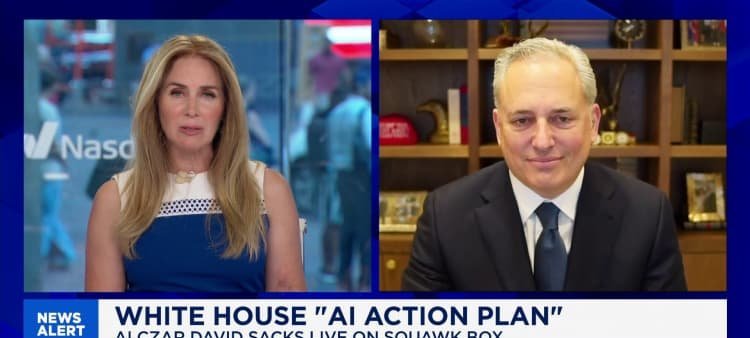
Imagem: Internet
Industry analysts note that AI companies are exploring a range of financing options, including long-term power-purchase agreements, direct investments in renewable energy and partnerships with cloud providers. OpenAI, whose valuation reportedly exceeds $80 billion, has indicated that further growth will depend on access to high-performance hardware and the ability to operate large-scale computing clusters around the world.
Market implications
The prospect of any federal guarantee, however limited, would draw scrutiny from lawmakers and taxpayer watchdogs. Critics of industrial policy often argue that picking winners and losers could distort market incentives, while supporters contend that strategic sectors—such as semiconductors, clean energy and AI—warrant targeted assistance. Sacks’ unequivocal statement appears intended to reassure skeptics that the administration favors a lighter-touch approach.
Financial markets reacted minimally to the exchange. Shares of publicly traded chipmakers and cloud infrastructure providers showed no significant volatility in Thursday trading, while privately held AI developers, including OpenAI, do not disclose daily valuation changes. Some investors interpreted Sacks’ comments as an affirmation that capital flows will continue to come primarily from venture funds, strategic partners and private-sector lenders.
Next steps
Sacks is scheduled to brief the White House Task Force on Artificial Intelligence Education in early September, following a session he attended in the East Room on September 4, 2025. According to people familiar with the agenda, the group plans to discuss workforce development, research funding and potential updates to federal procurement rules for AI services. It is not yet clear whether the issue of a potential backstop will surface again in those deliberations.
For now, the administration’s AI adviser has drawn a clear line: while Washington may aim to speed up permitting and support an adequate energy supply, it has no intention of offering a financial safety net to individual companies developing frontier models.
Crédito da imagem: Brian Snyder | Reuters