
Washington, D.C. — House Speaker Mike Johnson said Tuesday he does not believe there is a viable way for former President Donald Trump to pursue a third term in the White House, citing the explicit restrictions contained in the U.S. Constitution.
During a press briefing on Capitol Hill, Johnson, a lawyer with a background in constitutional law, told reporters he had spoken with Trump earlier in the morning about the matter. According to the speaker, both men acknowledged that the 22nd Amendment bars anyone from being elected president more than twice.
“From my perspective, there is no workable route to change that provision in time,” Johnson said, noting that amending the Constitution typically takes years because it requires two-thirds approval in both chambers of Congress followed by ratification from three-fourths of the states. “The timeline alone makes the prospect unrealistic,” he added.
Trump, currently traveling in Japan as part of a three-nation tour of Asia, has raised the topic several times in recent months. On Monday, when asked directly whether he would consider running again in 2028, he responded that he would “love to do it” and left open the possibility. The remark revived debate over presidential term limits, a question normally considered settled since the 22nd Amendment was adopted in 1951.
Constitutional Hurdles
The speaker’s comments underscored the difficulty of altering the nation’s foundational document. Amending the Constitution involves an arduous process outlined in Article V. Either Congress must propose an amendment with a two-thirds vote in both the House and Senate, or two-thirds of state legislatures must call a convention. In both scenarios, three-fourths of state legislatures, or state conventions, must ultimately ratify the change. Historical averages show that successful amendments often take several years to navigate the political and procedural hurdles.
For reference, the National Archives lists only one amendment adopted during the past half-century, illustrating how rarely the process succeeds.
Reaction to Campaign Merchandise
Speculation intensified earlier this year when the official merchandise site linked to the Trump Organization began selling hats emblazoned with “Trump 2028.” Johnson addressed the hats on Tuesday, calling them popular items among supporters but suggesting the design was primarily intended to provoke political opponents. “It is part of the former president’s style to keep critics off balance,” he said.
Despite dismissing the practical chance of a constitutional change, Johnson indicated that Republicans remain focused on advancing their legislative agenda during the remainder of Trump’s second term. “We are not easing up,” he told reporters, emphasizing domestic and foreign policy objectives the party hopes to achieve.
Bannon’s Recent Remarks
Talk of a third term also gained traction after former Trump adviser Steve Bannon said in a recent interview with The Economist that there was “a plan” to extend Trump’s time in office beyond the constitutional limit. Bannon did not provide specifics, and Johnson made no reference to the claim beyond reiterating that existing legal barriers appear insurmountable.
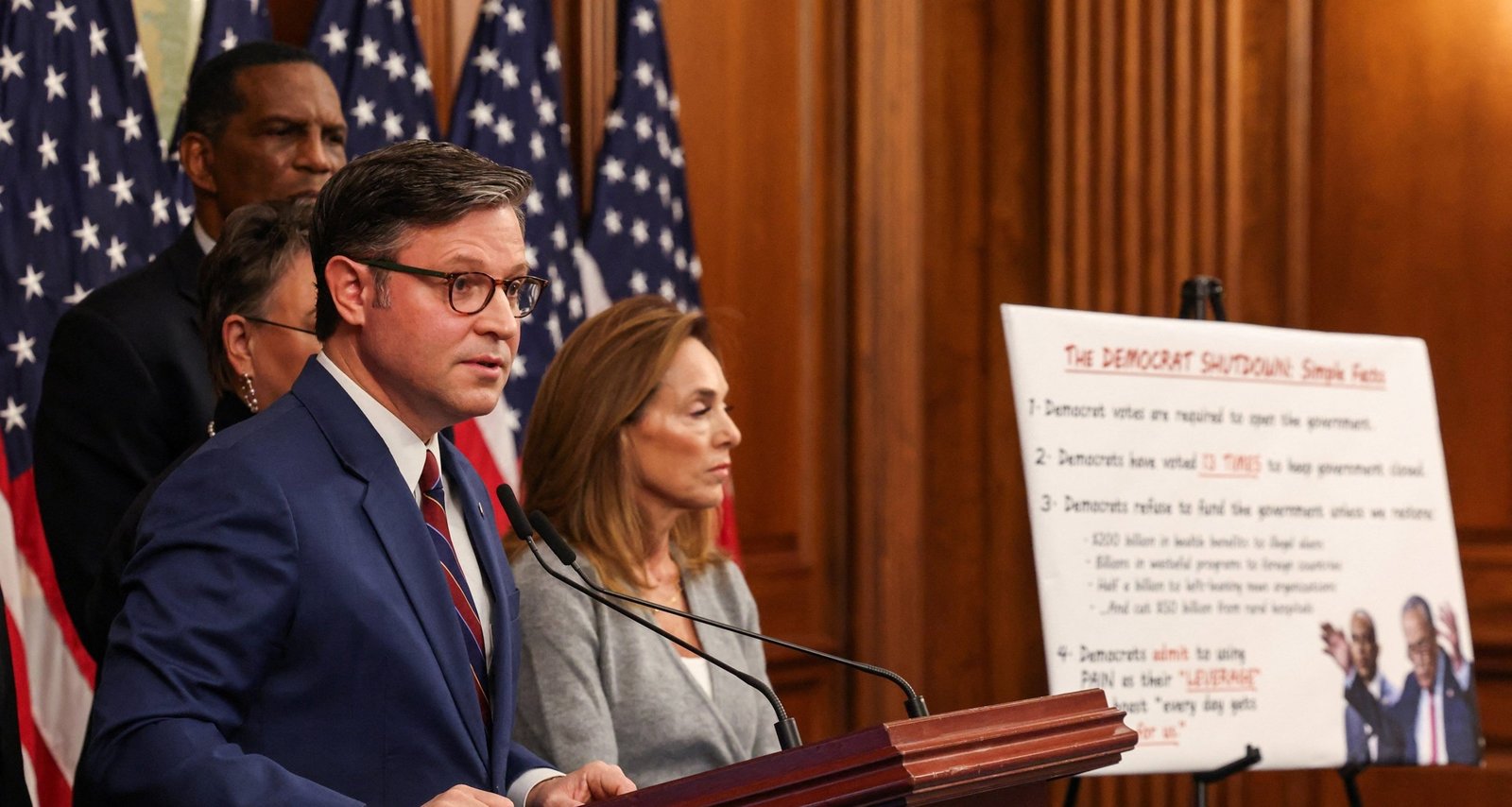
Imagem: Internet
Response From Democrats
Democrats have largely dismissed the idea of a third Trump campaign as legally impossible and politically speculative. While no official legislative action has been proposed to address the matter, key Democratic lawmakers have publicly reinforced that term limits stand as written. Johnson suggested that some opposition figures react strongly even to hypothetical scenarios, characterizing their response as “hair on fire.”
The 22nd Amendment
Ratified on February 27, 1951, the 22nd Amendment restricts any individual from being elected president more than twice. The measure was adopted in the aftermath of Franklin D. Roosevelt’s four-term presidency, which broke a longstanding informal precedent. Since its ratification, every president has observed the two-term limit, and no serious congressional effort to repeal or modify the rule has advanced to the ratification stage.
Legal scholars note that even if momentum were to build for a repeal, the earliest feasible completion date would likely fall well beyond 2028. Delays stem from the necessity of drafting amendment language, securing supermajorities in Congress, and then waiting for state legislatures to act.
Current Political Climate
With three years remaining in Trump’s second term, congressional leaders are preparing for budget negotiations, foreign policy challenges in Asia and the Middle East, and continued debates over domestic programs such as the Supplemental Nutrition Assistance Program. Johnson indicated that these issues, rather than the remote possibility of a constitutional overhaul, will dominate the legislative calendar.
For now, talk of a third Trump term appears confined to campaign merchandise, social media speculation, and occasional comments from the former president himself. Johnson’s unequivocal statement that he sees no path forward places the constitutional barrier firmly at the center of the discussion.
Crédito da imagem: Kylie Cooper/Reuters