
Financial markets turned lower on Tuesday, April 7, 2026, after U.S. President Donald Trump warned that “a whole civilization will die tonight” if Iran does not reopen the Strait of Hormuz by his self-imposed 8:00 p.m. Eastern Time deadline. The threat, delivered in a Truth Social post hours before the cutoff, put investors on edge and raised the prospect of military confrontation in one of the world’s most critical maritime corridors.
The Strait of Hormuz, responsible for a sizable share of seaborne crude and liquefied natural gas, has faced a chokehold for more than a month. Trump framed the current standoff as a potential turning point, suggesting decades of “extortion, corruption and death” could end if Tehran complies, while also cautioning that failure would trigger catastrophic consequences. Although the president’s language was apocalyptic, he noted that “something revolutionarily wonderful” could still occur, leaving a narrow opening for de-escalation.
Equity futures reacted immediately. Before the opening bell, contracts tied to the Dow Jones Industrial Average fell 142 points. S&P 500 futures slipped 0.4 percent, and Nasdaq 100 futures retreated 0.6 percent, signaling a broad risk-off mood. Once trading began, the Nasdaq Composite declined 0.6 percent, the S&P 500 dropped 0.42 percent, and the Dow opened 0.3 percent lower, extending pre-market weakness.
Energy prices jumped as traders assessed the possibility of supply disruptions through the 21-mile-wide waterway. West Texas Intermediate surged above $115 per barrel, while Brent crude climbed beyond $110. According to the U.S. Energy Information Administration, roughly one-fifth of global oil consumed daily transits the strait, underscoring its strategic importance and the market’s sensitivity to threats in the region.
Cryptocurrency markets were not spared from the volatility. Bitcoin slipped 1.2 percent over a 24-hour period to about $68,557. Ethereum lost 2.6 percent, trading near $2,089. Solana and XRP registered sharper declines of 3.9 percent and 2.5 percent, respectively, as digital-asset traders adopted a defensive posture.
Several secondary developments added to the day’s uncertain tone. Strategy, the bitcoin-focused vehicle controlled by billionaire Michael Saylor, reported an unrealized loss of roughly $14.5 billion. Separately, an analyst revisited expectations for U.S. Federal Reserve rate cuts later in 2026, and one American state pressed forward with a proposal to exempt certain cryptocurrency transactions from taxation. While each headline carried its own implications, none matched the immediate market impact of the White House ultimatum.
Trump’s Tuesday post was the latest in a series of escalating statements aimed at forcing Tehran to reopen the strait. Over the past month, Iranian forces have intermittently blocked or slowed tanker traffic, citing security concerns and regional tensions. The administration has repeatedly threatened unspecified “decisive action” should those activities continue, but it had not assigned a public deadline until the president’s April 7 social-media update.
Investors weighed the potential scenarios: a diplomatic breakthrough that restores shipping lanes without conflict, or a military strike that could disrupt energy flows and ripple through global supply chains. The president’s suggestion that “decades of extortion” might end if Iran complies offered one path toward stability, yet his vow that “a whole civilization will die” if diplomacy fails highlighted the risks markets now face.
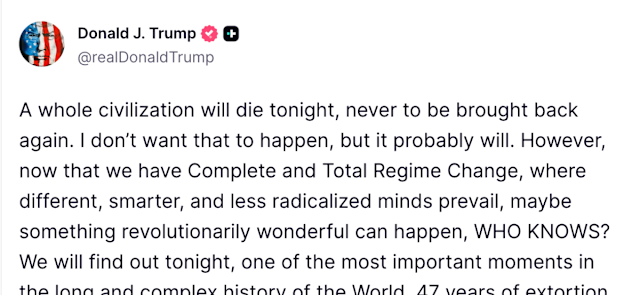
Imagem: Internet
By mid-afternoon trading in New York, defensive sectors such as utilities and consumer staples outperformed, while transportation and technology shares lagged. The U.S. dollar edged higher against major peers, reflecting a flight to perceived havens. Gold prices firmed, adding to evidence of investors seeking shelter ahead of the 8:00 p.m. deadline.
In energy markets, traders continued to build in a geopolitical premium. Options activity suggested growing demand for protection against further oil price spikes, and several shipping insurers reportedly widened exclusion zones around the Gulf region. Freight rates for very large crude carriers bound for Asia also advanced, mirroring concerns over prolonged shipping delays.
Market participants awaited additional guidance from the administration and any response from Tehran. The State Department had not released a formal statement by early afternoon, and Pentagon officials offered no comment on potential military plans. Diplomats from several European countries were said to be working behind the scenes to encourage a negotiated solution, though no meetings were publicly announced.
As the deadline approached, traders monitored energy terminals, satellite imagery and ship-tracking data for signs of movement within the strait. Any indication that Iran might remove barriers could spark a relief rally; conversely, continued obstruction or a direct clash would likely exacerbate selling across risk assets.
The final hours before 8:00 p.m. held broader implications beyond immediate market swings. A forceful U.S. response could affect defense spending, global alliances and long-term energy strategies, while a peaceful resolution might pave the way for renewed diplomatic engagement. For the moment, however, investors focused on short-term positioning, with volatility expected to stay elevated until definitive news emerges.